Table of Contents
Why Treating AEO as 'Just SEO' is the Most Expensive Mistake Marketing Teams Are Making in 2024
The words that could cost your company millions in market share
You know that moment when your team walks into your office and says, "Don't worry about this new thing – it's just like what we're already doing"?
I've watched executives nod along to this exact phrase countless times over the past two decades. "Social media is just another marketing channel." "Mobile is just another screen size." "Video content is just another format." Every single time, the companies that bought into this logic got steamrolled by competitors who understood these weren't incremental changes – they were fundamental shifts requiring entirely new approaches.
Well, it's happening again. And this time, the stakes are higher than ever.
If your team just told you that AEO (Answer Engine Optimization) is "just SEO," they may have unknowingly sentenced your company to irrelevance in the next five years. Here's what I mean by that, and why the smartest marketing leaders are treating this as a content strategy revolution, not a technical evolution.
The AEO Success Stack: Why Sequential Thinking Beats Spray-and-Pray
Mike King, the two-time Search Engine Land Marketer of the Year, put it bluntly: "It is a profound mistake to say that optimizing for generative AI is just SEO... from a straight up business perspective, all the business people that are hearing you say that are thinking that you don't understand business and you're going to miss out on opportunities for yourself."
That's harsh. But it's also accurate.
The reason most AEO initiatives fail isn't because the tactics are wrong – it's because companies approach it like they're optimizing for Google in 2015. They skip the foundation and jump straight to the tactics. What actually works is what I call the AEO Success Stack, and it requires building in sequence.
Think about it this way: most companies try to win a game they can't even see the scoreboard for. The measurement foundation isn't just "nice to have" – it's the difference between strategic investment and expensive guesswork. You need to know where you currently stand across all major answer engines compared to your competitors. (HubSpot's AEO Grader tool is brilliant for this, by the way.) Without this baseline, you're optimizing in the dark.
But here's where it gets interesting – and where the "just SEO" thinking completely breaks down.
Once you can measure your current visibility, you discover that LLMs are fundamentally different consumers of content than search engines. They're what King calls "lazy readers." If you throw walls of text at an LLM, if you bury multiple concepts in one section, the chances of it extracting your information plummet. This isn't about keyword density or meta descriptions – this is about restructuring content into atomic units, one concept per paragraph, with clear data points that establish your site as an authoritative source.
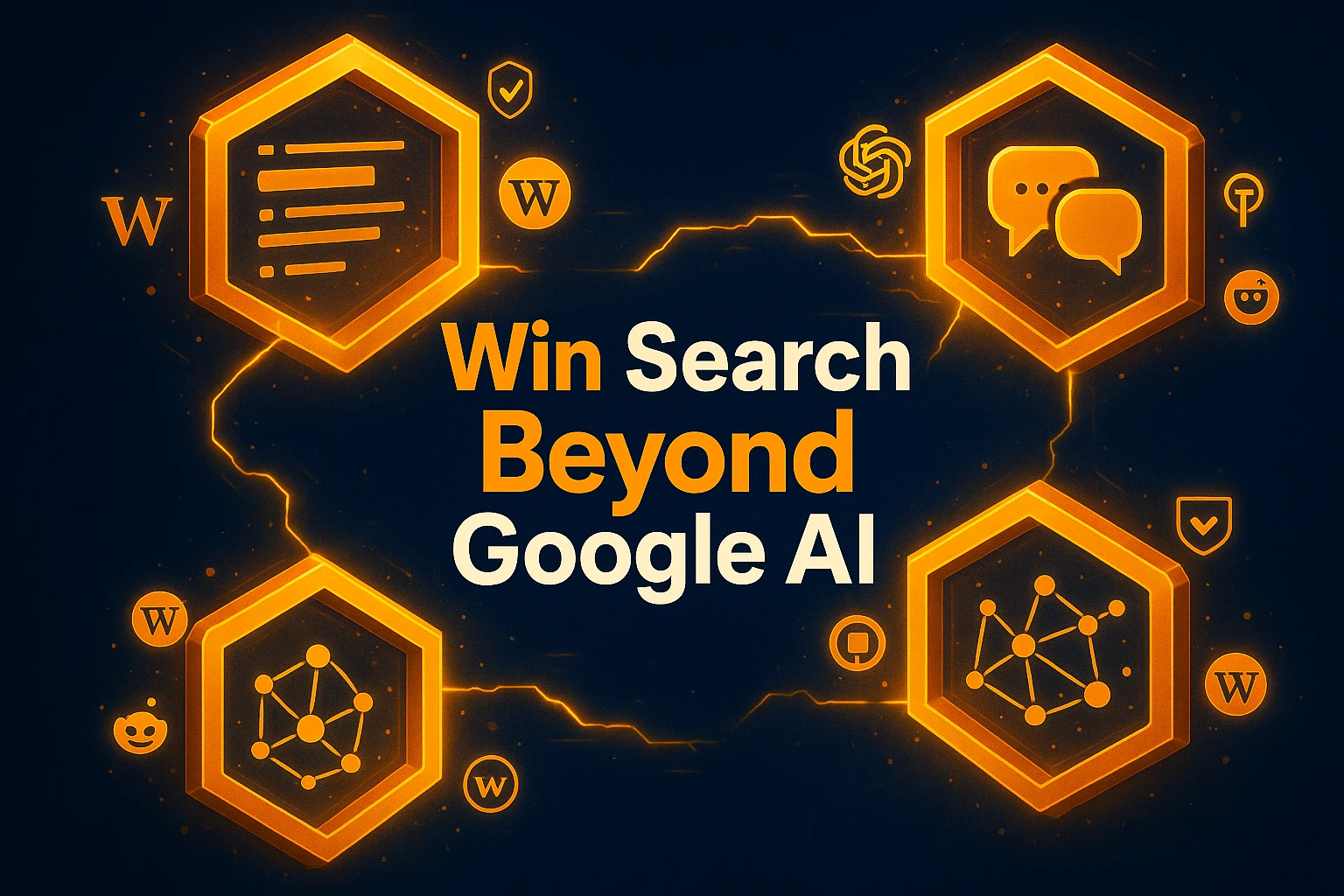
The final layer? Creating what I think of as consensus across the web. King uses a perfect analogy here: "The way I think about how this stuff works is it's like a raffle and you're creating as many raffle tickets as possible across the web so that you can win that raffle." This isn't link building – it's message amplification. Reddit engagement, digital PR campaigns, microsites, community management – all reinforcing the same core messages and data points.
Most companies try to start with Layer 3 (amplification) because it looks like traditional marketing. But without Layers 1 and 2, you're amplifying the wrong messages to systems that can't properly consume them.
The Million-Dollar Proof Point (And Your Action Plan)
I know a company that learned this lesson the expensive way. HubSpot discovered their pricing page was JavaScript-rendered and completely invisible to ChatGPT. Potential customers were asking AI tools about HubSpot's pricing, and the tools were sourcing information from competitors or outdated third-party sites.
The fix? They published structured pricing blog posts – atomic units of content with clear headings, bullet points, and tables. The result was immediate: pricing accuracy across all AI services went up significantly. Think about the business impact of that for a second. Every incorrect pricing answer was either sending customers to competitors or forcing your sales team to overcome misinformation.
So here's my practical advice if you want to avoid that same expensive lesson:
- First, audit where you actually stand. Stop assuming and start measuring. Use tools that show your current visibility across AI platforms versus your competitors. Focus initially on branded terms and pricing information – these are the highest-stakes queries where accuracy matters most.
- Next, fix your content architecture. Ensure your most important information isn't trapped behind JavaScript barriers. Structure content so that each paragraph focuses on one concept. Use clear headings, bullet points, and tables. Create unique data points that only your company would know – this establishes authority in ways that LLMs recognize.
- Finally, build your raffle ticket system. Develop a coordinated strategy where your key messages and data points appear consistently across multiple platforms. This isn't about volume – it's about relevance and consistency. When AI tools do their synthetic queries, they should keep encountering your messaging everywhere.
The companies getting this right aren't treating it as a technical SEO problem. They're treating it as a content strategy problem that requires cross-functional alignment between content, technical, and business teams.
The Window Is Closing Faster Than You Think
I was looking at some Semrush data the other day, and what I found was staggering: they're predicting ChatGPT traffic could overtake Google by 2028. That sounds like a long time, but companies need 2-3 years to build the proper capabilities and organizational alignment for AEO success.
The math is simple and terrifying: the window for competitive advantage is closing rapidly. Early adopters are already capturing AI-driven traffic and controlling their brand message across answer engines. Late adopters will find themselves defending market share instead of expanding it.
If your organization is still treating AEO as "just SEO," you're not just missing an opportunity – you're actively choosing to let competitors define your brand in the new search landscape.
The question isn't whether AEO will matter. The question is whether you'll be ready when it does.