Table of Contents
AI Search Fragmentation: Why Dominating Google's AI Overviews Won't Win You ChatGPT (And What This Means for Every Business)
The uncomfortable truth about AI search that's costing companies millions in missed opportunities
If you think winning Google's AI search means you're winning AI search, you're about to get a reality check that could save your business.
I know exactly what this feels like. You finally crack Google SEO, celebrating your rankings and traffic growth, only to discover your biggest competitor is dominating voice search, or social search, or some other channel you completely ignored. You optimized for one algorithm while your audience quietly moved to three others.
Here's what kept me up last night: We're living through this exact scenario right now with AI search, but most businesses have no idea it's happening.
Think about this for a second. United Healthcare – a $400 billion company with 4.4 million monthly visitors and 97,000 keywords ranking – absolutely dominates Google's AI Overviews with 17% visibility. They're the undisputed champion. But when I looked at their performance in ChatGPT? They drop to third place. Third.
And that's only a problem if you care about the hundreds of millions of people moving their search behavior from Google over to ChatGPT and Perplexity. (Spoiler alert: you should care.)
The AI Citation Trinity Strategy
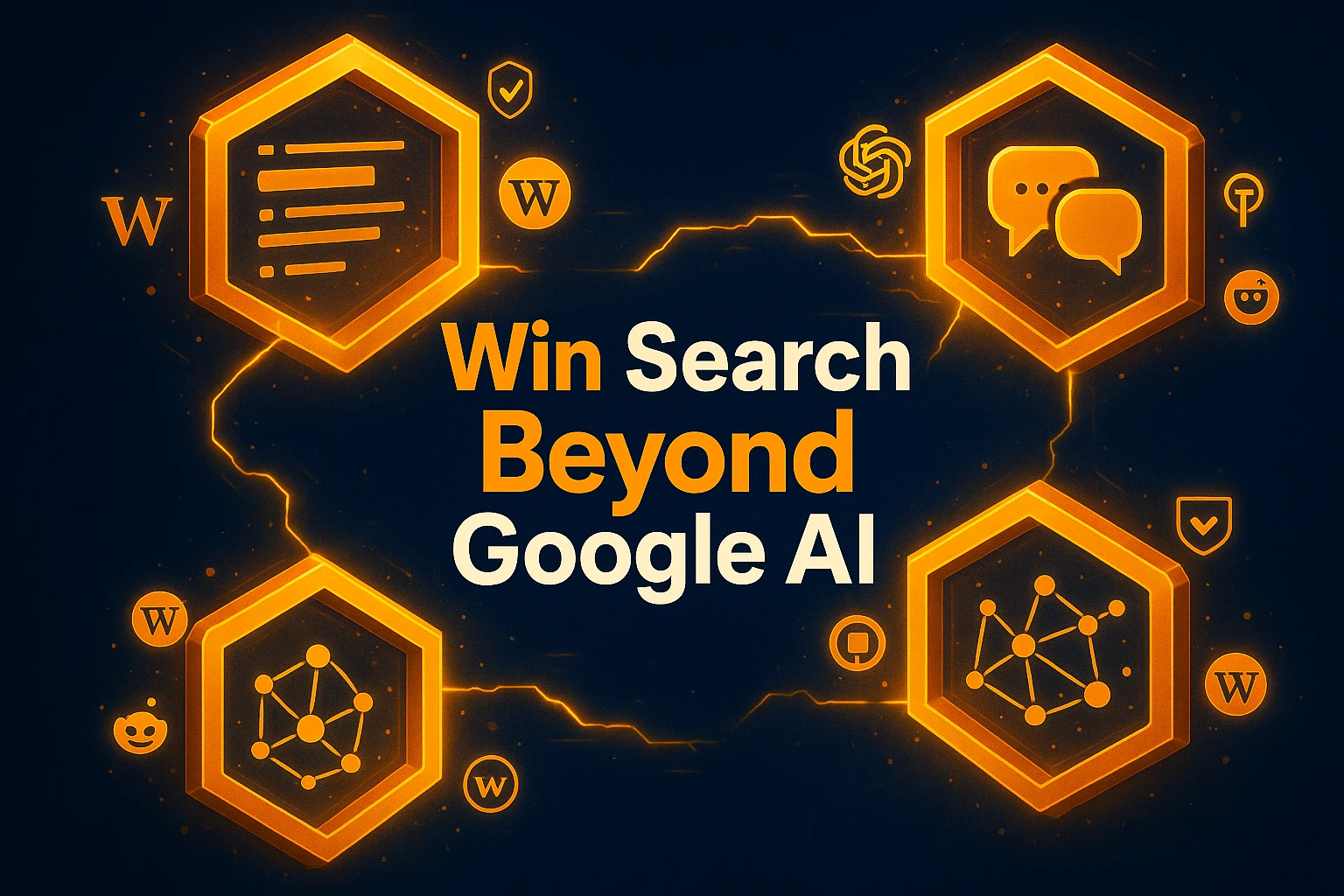
What we're dealing with isn't one AI search algorithm. It's three completely different games, each with its own rules, preferences, and winning strategies.
I call this the AI Citation Trinity Strategy, because mastering AI search visibility means understanding how three distinct platforms decide what to cite and recommend.
The first platform in this trinity is Google AI Overviews – those AI-generated responses that appear directly in Google search results. Here's what most people miss: Google's AI has a massive government bias. When someone searches for health insurance information, healthcare.gov gets cited 44% of the time. Mayo Clinic and WebMD dominate with over 20% citation rates each. It's an authority play, pure and simple.
But here's where it gets interesting. ChatGPT plays by completely different rules. That same healthcare.gov site that Google loves? ChatGPT only cites it 9% of the time. Instead, Wikipedia becomes the second most cited source, and citations get spread across a much wider range of websites. It's less about government authority and more about comprehensive, neutral information.
Then there's Perplexity, which might be the most surprising of all. Reddit dominates Perplexity citations at 35%. If you want Perplexity to recommend you as a health insurance provider in the US, you literally need to be talked about on Reddit. Not government sites. Not medical authority sites. Reddit threads.
See the problem? Each platform has fundamentally different source preferences. Success in one doesn't predict success in the others.
The Proof Is in the Performance Gap
I've been studying this with data from Peak.ai, and the results are staggering. Take Age Care Bathrooms – a company dramatically smaller than United Healthcare. Through targeted digital PR and strategic authority positioning, they managed to dominate ChatGPT recommendations in their space while larger competitors focused solely on Google.
Size doesn't determine success here. Strategy does.
The numbers tell the real story. United Healthcare's dominance in Google AI Overviews (17% visibility) completely evaporates in ChatGPT, where they fall to third place. Meanwhile, their competitors are quietly building authority on Wikipedia, engaging authentically in Reddit communities, and securing citations across the diverse sources that ChatGPT and Perplexity actually prefer.
So if I were to give you one piece of advice, it would be to start with an immediate AI platform audit. Test your brand visibility across all three platforms using the same queries your customers would use. You'll probably discover some uncomfortable truths about where you're winning and where you're invisible.
The first practical step? Stop assuming AI search is monolithic. Create a "citation shopping list" for each platform. For Google AI, focus on getting mentioned by government sites and established medical authorities. For ChatGPT, prioritize Wikipedia presence and diverse, credible sources. For Perplexity, engage authentically in relevant Reddit communities where your expertise adds genuine value.
The Bottom Line
Just because you're winning in traditional search doesn't mean you're going to win in every area of this new AI search landscape.
The companies that recognize AI search fragmentation now – while their competitors still think it's one unified game – will own the visibility advantage for the next decade. The companies that don't? They'll keep celebrating their Google rankings while their customers find solutions elsewhere.
Your move.