Table of Contents
Why Smart Marketers Build Campaigns Backwards: The End-First Strategy That Creates 'How Did They Know That?' Moments
The counter-intuitive approach that turns disjointed touchpoints into seamless customer journeys
Picture this: You've just launched what feels like your best campaign yet. The social posts are getting engagement, the creative is on-brand, and the initial metrics look promising. Then you dig into the conversion data and... ouch.
People are clicking through, but they're not sticking around. Your beautifully crafted Instagram post leads to a landing page that feels like it was designed by a completely different team. The follow-up email that arrives three hours later? It might as well be from another company entirely.
I see this disconnect everywhere, and it's painful because it's so avoidable. The problem isn't your content quality or your design skills. The problem is that you're building forward when you should be building backward.
The 5-Step Backwards Campaign Blueprint
Here's what most marketers do: They start with content creation, then scramble to build supporting pages and emails around whatever they've already produced. It's like decorating a house before you've laid the foundation.
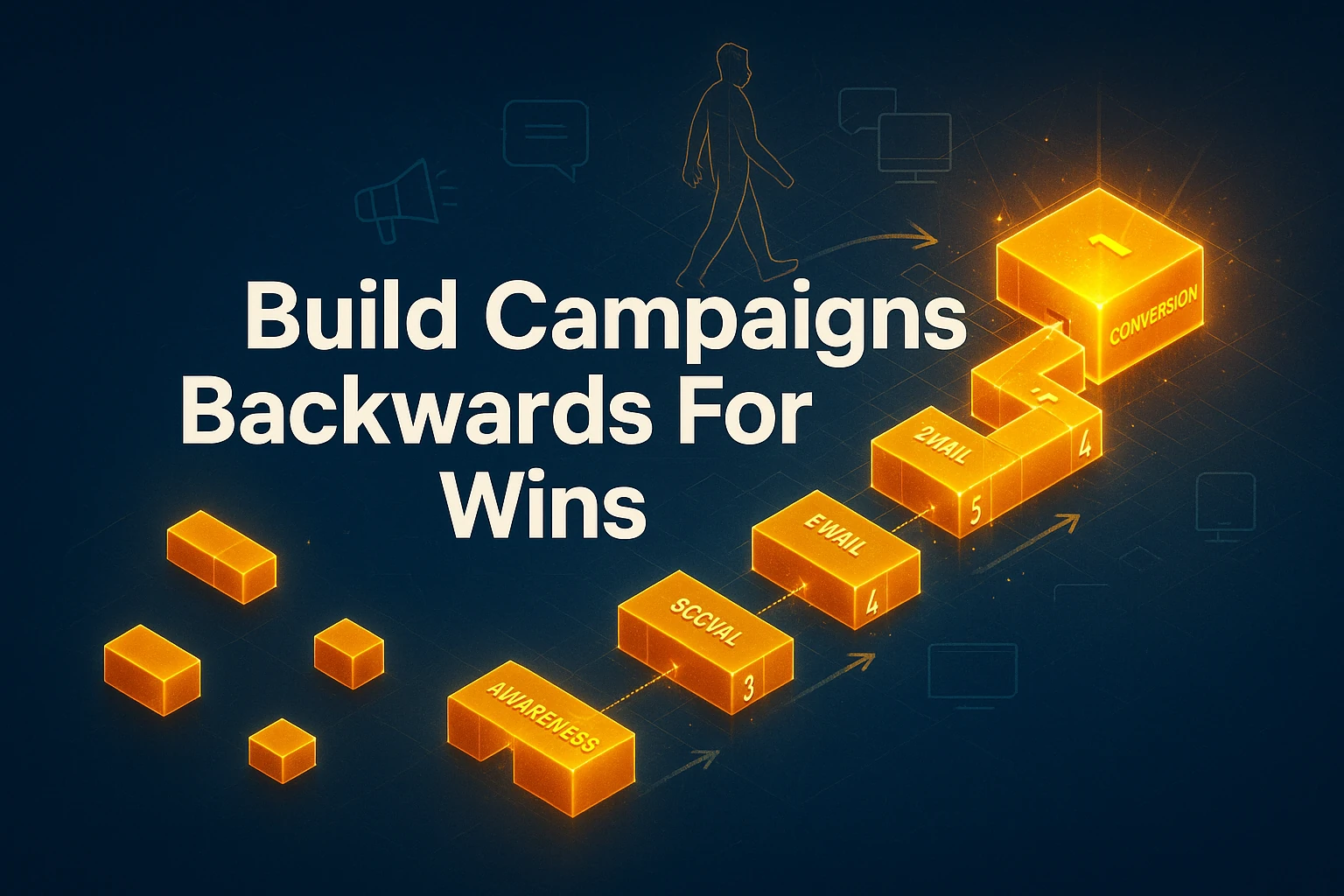
The smartest marketers I know do the opposite. They use what I call the 5-Step Backwards Campaign Blueprint – and the results speak for themselves.
Think of it like planning a dinner party. You don't start by buying random ingredients and hope they work together. You start with the final experience you want your guests to have, then work backwards to plan every course, every detail, every moment that leads to that perfect ending.
What does mapping the complete customer journey before building anything actually look like? It starts with understanding exactly how someone moves from discovering your brand to becoming a customer. Before you write a single social post or design a single landing page, you need to see the entire path laid out.
Then comes the counterintuitive part: designing your final touchpoint first. When you know where the end of your lead capture journey is – that first real message your audience will see in their inbox – it becomes way easier to work backwards and design everything else around it. This email becomes your north star, the quality standard and voice that everything else must match.
Next, you're building your landing page as the central hub, but here's the key: you're structuring it around what your audience actually wants to know, not what you want to tell them. Every element serves the journey you've already mapped out.
Only then do you create content with a specific destination in mind. Instead of hoping great content will somehow convert, you're designing every post to drive people to that carefully crafted landing page experience.
Finally? You test the entire system before anyone else sees it. Because the most brilliant campaign strategy in the world falls apart if someone can't actually complete the journey on their mobile device.
The Proof Is in the Performance
I watched this approach work firsthand with a campaign that started as essentially a joke. The Trailmates Forzy campaign – a play on hiking gear that was purposefully over-the-top – hit 50,000 organic views and generated 422 pre-order signups in one week. Not because the content was revolutionary, but because every single touchpoint in that campaign was designed to support the next step in the journey.
The social content made people stop and smile. The landing page answered exactly the questions that content had raised. The confirmation email felt like a natural continuation of the conversation. No jarring transitions, no "wait, where am I?" moments.
Think about this for a second: when was the last time you went through a marketing campaign that felt that seamless? Where each step felt intentionally connected to the next?
If you're being honest (and I hope you are), it's probably rare. And that's exactly why this approach works so well – most of your competition is still building forward, creating those disconnected experiences that make customers second-guess their decision to engage.
So here's my challenge: audit your last campaign. Did each touchpoint feel connected to the others? Did the journey feel intentional, or did it feel like you were making it up as you went along?
Because here's what I've learned after years of both approaches: your landing page and email are only as good as the number of people who actually see them. But more importantly, people will only complete a journey that feels like it was designed with them in mind.
The backwards approach isn't just about better conversion rates (though you'll definitely see those). It's about building the foundation for campaigns that make your audience think, "How did they know that?" – and keep them coming back for more.