Table of Contents
The 80/20 Marketing Paradox: Why Your Sales Team Is Doing Marketing's Job (And Killing Your Scale)
If your sales team is doing the convincing, you've already lost the scale game
Picture this: You're running a six-figure coaching business. Your leads look great on paper, but your close rates are inconsistent. Some days your closer converts 60%, other days it's 20%. You think the problem is obvious, hire better salespeople, pay higher commissions, maybe add another closer to the team.
Sound familiar? (If you've been in business longer than five minutes, I'm betting it does.)
Here's what I've discovered after watching hundreds of knowledge businesses hit the same wall: You're trying to scale the wrong part of your business. And that's not just expensive, it's nearly impossible.
I was talking to a business owner the other day, let's call him Andre, who was doing $619K in revenue with $409K profit in just six months. Impressive numbers, right? But here's the kicker: he could barely push his ad spend past $7,500 monthly, and only 2% of his customers paid in full. Despite the strong margins, he'd hit a scale ceiling that felt like concrete.
The problem wasn't his product. It wasn't his market. It wasn't even his sales team.
It was his Marketing-Sales Conversion Ratio.
The Framework That Changes Everything
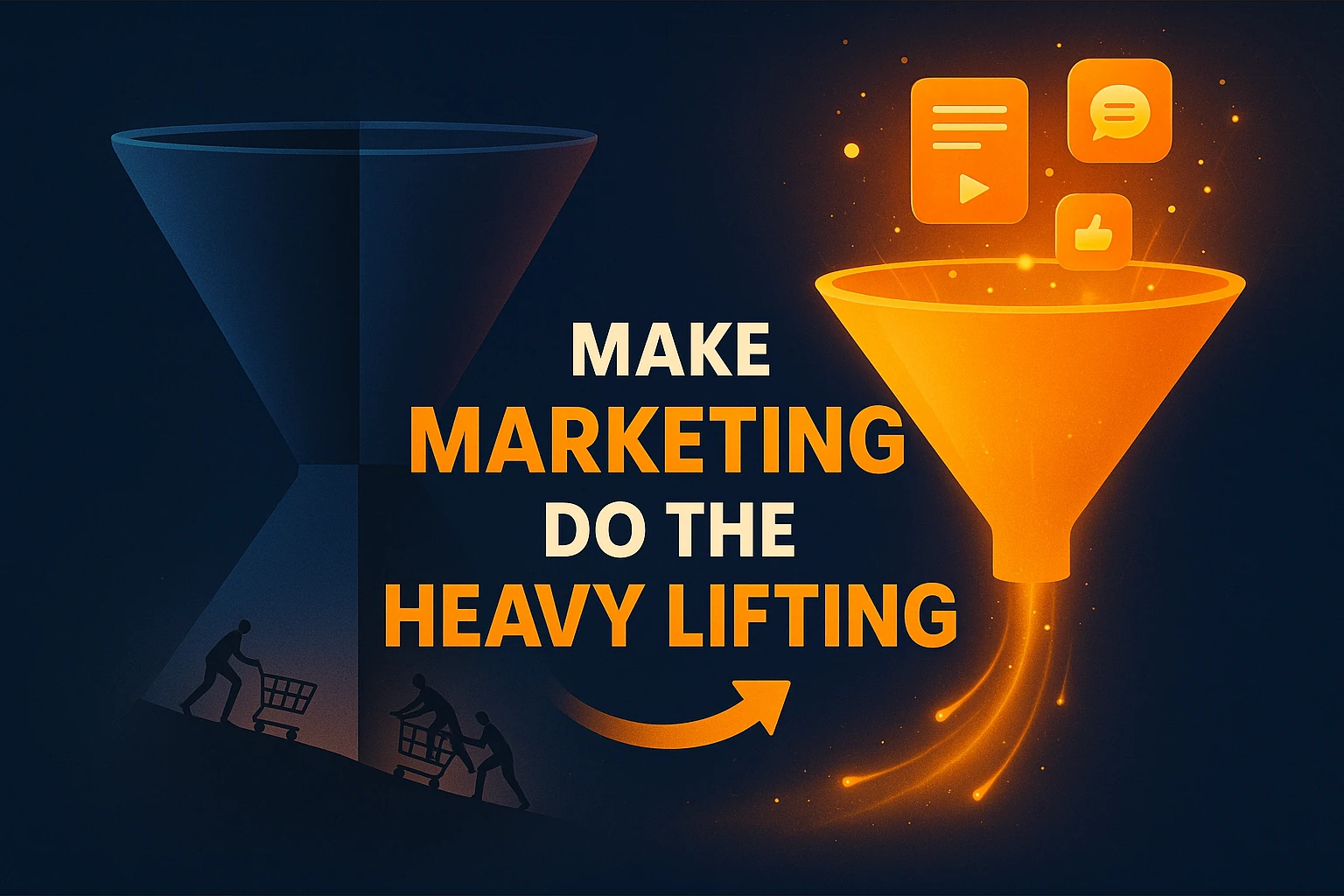
Most businesses operate on what I call the "traditional model", about 20% of conversion happens in marketing, and 80% happens on the sales call. Your closer has to educate prospects from scratch, overcome objections, build credibility, and somehow convince someone who showed up skeptical to hand over their credit card.
But here's where it gets interesting (and this is going to sound backwards at first): The most scalable businesses flip this completely upside down.
What does an 80/20 marketing-heavy model look like? It means 80% of the conversion work happens before your prospect ever talks to a human. Through your content, your story sequences, your social proof, everything that builds your profile funnel and establishes your expertise. By the time they book a call, they're not asking "Should I buy?" They're asking "How do I buy?"
Think of it like this: Content is the ultimate employee. It works 24/7, never calls in sick, and doesn't ask for a raise. People don't.
The magic happens when everything in your ecosystem is perfectly synced. Your ads, your organic content, your email sequences, and yes, your sales conversations, all reinforce the same message and positioning. It's not just alignment; it's orchestration.
I know a business coach who figured this out. His team achieves 70-75% close rates consistently because, as he puts it, "everything is perfectly synced" between marketing and sales. His prospects show up pre-sold. His sales calls become consultations, not convincing sessions.
The Real Cost of Getting This Wrong
Here's what happens when you try to scale with the 20/80 model: You hit a hiring ceiling fast. Good closers are expensive and hard to find. Your conversion rates fluctuate based on who's having a good day. You're burning cash on commissions instead of building scalable marketing assets that compound.
And here's the part that really stings, your prospects arrive defensive instead of excited.
So if I were to give you one piece of advice, it would be this: Start measuring where your conversion actually happens. Ask your next ten prospects two simple questions: "What convinced you to book this call?" and "What questions do you still have?"
If they're saying things like "I wanted to learn more about your program" or "I'm not sure if this is right for me," you're operating in sales-heavy mode. If they're saying "I've watched your content for months, I just need to understand the logistics," you're getting closer to marketing-heavy.
The first practical step? Stop trying to create educational content and start building your credibility stack. Document your best sales conversations and turn those common objections into marketing content. Build story sequences that establish your expertise before anyone books a call.
But here's the crucial part, and this is where most people mess up, everything needs to connect. Your Facebook ads can't promise one thing while your Instagram content talks about something completely different. Mixed messages create confusion. Confusion kills conversions.
The Payoff Is Everything
When you nail the 80/20 marketing-heavy model, something almost magical happens. Your cost per acquisition drops because you're attracting better prospects. Your lifetime value increases because educated customers make better customers. You build a business that scales through systems, not just star performers.
Most importantly, you break free from the scale ceiling that keeps most knowledge businesses stuck below seven figures.
So here's my challenge for you: Calculate your own marketing-sales conversion ratio. Be honest about where the real convincing is happening. If your sales team is doing marketing's job, it's time to flip the script.
Because content scales infinitely. People don't.