Table of Contents
The Creative Bias Trap: Why Your Marketing Intuition Is Sabotaging Your Ad Performance
When expertise becomes your enemy and simple beats sophisticated every single time
You're sitting in that creative review meeting again. Three ad concepts spread across the conference table, and you can practically feel the confidence radiating from your gut. The sticky note testimonial? Obviously going to crush it. The high-production video with all those factory shots? Safe money. That simple black screen with yellow text? Come on, that's what someone throws together in five minutes.
Three weeks later, you're staring at campaign results that make absolutely no sense. Your "obvious winner" burned through maybe $100 before the algorithm gave up on it. Meanwhile, that throwaway creative you barely glanced at? It's sitting pretty at $50,000+ in spend with a 1.5% click-through rate.
If you ask me, this is the most expensive blind spot in all of performance marketing.
The Creative Bias Stack: How Your Brain Betrays Your Budget
Here's what I've discovered after watching seasoned marketers get humbled by their own expertise over and over again. We don't just have one bias problem, we have three, and they stack on top of each other like a house of cards built on quicksand.
Think of it like this: every layer of marketing experience you gain adds another filter between you and what actually works. The more sophisticated your thinking becomes, the further you drift from customer reality.
At the foundation, there's what I call the pattern recognition trap. You see a sticky note testimonial work once, twice, maybe ten times, and suddenly your brain locks onto "sticky notes always work, right?" (Those were the exact words of a creative strategist I know who just watched his sticky note ad fail spectacularly.) This isn't logical thinking, it's pattern bias wearing the mask of experience.
But it gets worse. Layer two is where we start overvaluing complexity. More production value must mean better performance, right? Wrong. I watched Portland Leather's high-production studio video with sketches and factory footage become their top performer, but not because it was complex, because it told a compelling story. Meanwhile, another brand's "professional" approach with all the bells and whistles couldn't even crack the top 15.
The killer is layer three, personal preference bias. This is where we project our own aesthetic sensibilities onto our audience. We think price anchoring should work because it's logical. We prefer layouts that look designed because they appeal to our marketer sensibilities. But here's the brutal truth: what appeals to you as a marketer often differs dramatically from what converts customers.
And that's the core of it. No, wait, that's not quite right. The real core is that these biases compound. You don't just fall into one, you fall into all three simultaneously, making you confidently, expensively wrong.
When Simple Beats Sophisticated (And Your Predictions)
Let me tell you about three campaigns that should keep every creative director awake at night.
First, there's the Humantra Black Friday situation. One ad was just a black screen with Trustpilot reviews and some yellow graphics. Basic. Almost embarrassingly simple. The other had a sticky note testimonial (because those always work, remember?). The simple black screen ad hit 1.5% CTR and spent over $50,000. The sticky note? Couldn't even break $100 in spend.
Then there's the soap company that made their top 5 performing ad with an iPhone photo taken in their office bathroom. Not kidding. The founder literally grabbed some soap bars, held them in his hand, and snapped a picture by the sink. It outperformed professionally designed layouts with strategic price anchoring by a mile.
The pattern here isn't that simple always wins, it's that authentic, verifiable social proof consistently outperforms clever creative elements. When customers can fact-check something (like those Trustpilot reviews), they trust it more than your designed testimonials or strategic layouts.
Here's my take on what this means practically: Before you review any creative, write down your prediction and the reasoning behind it. Document which elements you're naturally drawn to and why. I guarantee you'll start noticing your bias patterns within a week.
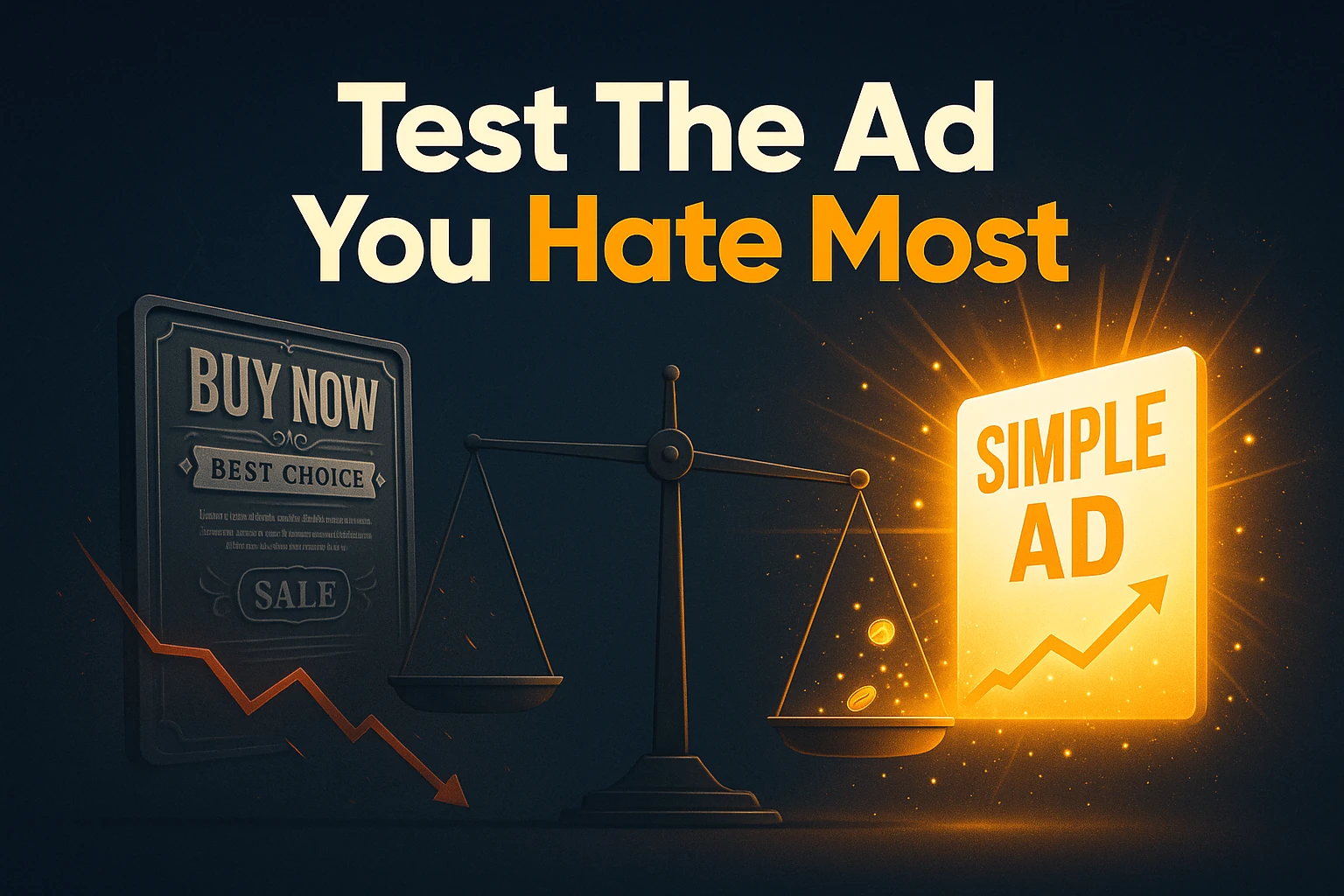
The first practical step? Stop trying to outsmart your audience. If you find yourself gravitating toward complexity, force yourself to test the opposite. If testimonials are your go-to, test product demos. Always include at least one creative that goes against your instincts, because your "wrong" choice might be the winner.
Most importantly, prioritize elements your customers can verify independently. Real ratings, actual reviews, third-party validation. These consistently outperform creative cleverness because trust beats design every single time.
The Overconfidence Penalty
Here's what nobody talks about: the more experienced you become at marketing, the worse you get at predicting creative performance. Not better. Worse.
Your expertise isn't just failing to help you, it's actively sabotaging your budget allocation. While you're confidently picking obvious winners based on proven patterns, the market is rewarding counter-intuitive creative choices that your bias stack can't even see.
So here's your challenge: In your next campaign, test the creative concept that makes you most uncomfortable. The one that feels too simple, too basic, or just "wrong" according to everything you know about marketing.
Because apparently, everything you know might be exactly what's holding you back.