Table of Contents
SEO is Dead? Wrong. It's Now 'Search Everywhere Optimization' - Why Smart Brands Are Winning While Others Panic
While most marketers spiral into traffic anxiety, the winners quietly adapted to where search really happens now
You know that sinking feeling when you open Google Analytics and watch your organic traffic numbers drop month after month? You're not alone. Every marketer I talk to is dealing with the same gut punch, watching dashboards that used to be their pride and joy now tell a story of decline.
But here's what's fascinating (and a little infuriating): while you're questioning everything you thought you knew about SEO, there are companies out there, 9-figure brands, that aren't just surviving this shift. They're absolutely crushing it.
The difference? They stopped optimizing for a world that doesn't exist anymore.
The Search Everywhere Optimization Stack
What most people call "the death of SEO" is actually its evolution. I've started calling it the Search Everywhere Optimization Stack, and once you understand it, the panic stops and strategy begins.
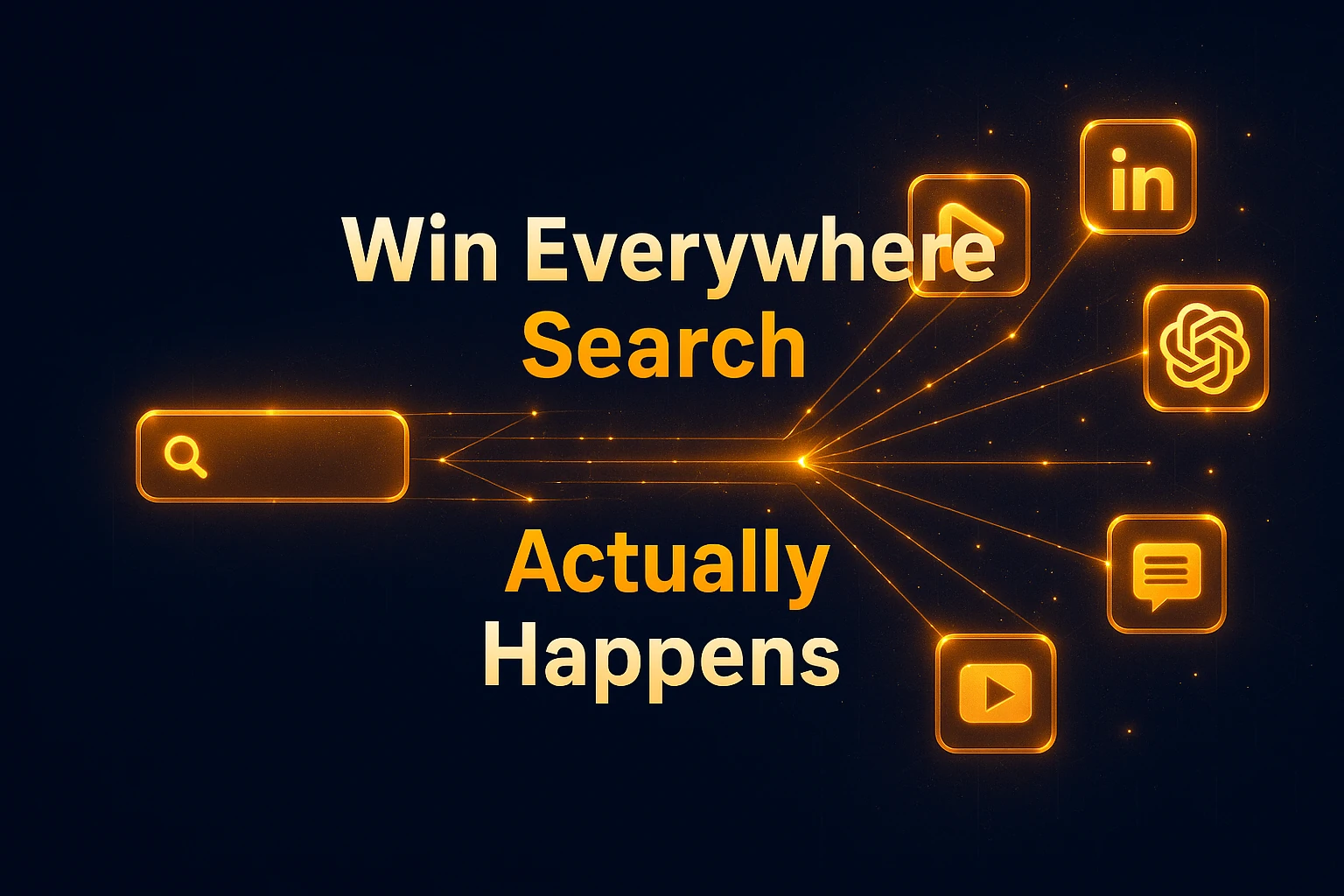
Think of it like this: we used to live in a world where "search" meant one thing, that little Google box. But now? Search happens everywhere. People search on YouTube for how-to content. They search LinkedIn for industry insights. They ask ChatGPT for recommendations. They scan Reddit for honest opinions.
The traditional approach, what I call Google-only optimization, focused entirely on keywords and pages. Back then, we created content with an 80/20 split: 80% informational ("how to do X") and 20% transactional ("buy our solution"). That world is gone.
The current reality demands multi-platform search thinking. YouTube is the second largest search engine in the world. LinkedIn organic results actually show up on Google. And here's the kicker, the content ratio has flipped. Smart brands are now pushing 50/50, even 80% transactional content because that's what actually converts in this new landscape.
But wait, it gets more interesting. The future belongs to what I call brand signal amplification. This is where LLMs like ChatGPT scan the entire internet for brand mentions, reviews, citations, and sentiment. It's not just about having content, it's about having your brand talked about consistently across every platform where conversations happen.
Here's How Winners Are Actually Winning
I know an agency owner who works with publicly traded companies doing billions annually, and his Marketing School podcast is approaching 2,000 reviews. When you ask ChatGPT for the "best marketing podcast," guess what comes up #1 or #2? That's not an accident. That's brand signal amplification working exactly as designed.
Their Seth Godin interview alone got 100,000 long-form views. But here's the brilliant part, they didn't just post it once. They turned that single 80-minute conversation into 5-10 native pieces across platforms. Sixty-second snippets for Instagram. Thoughtful threads for X. Professional insights for LinkedIn.
Even though traffic is going down right now, I want to cite that publicly traded companies are saying that traffic is coming down but the conversions are actually flat or even going up. Quality over quantity isn't just a platitude anymore, it's measurable reality.
Need proof this works tactically? A LinkedIn post for a product launch called "Carrot" drove 800 leads, with 100 enterprise-qualified prospects from companies doing billions in revenue annually. The post got 200,000 views. One post. Native optimization. That's the power of understanding where your audience actually searches.
The Three Moves Smart Brands Are Making Right Now
If I were to give you one piece of advice, it would be to start with content consolidation. Most companies have 20 different pages about "what is SEO." Pick the best one, beef it up into the ultimate resource, and delete the rest. LLMs prefer comprehensive, consolidated content that's easy to crawl and cite.
The second practical step? Stop ignoring AI overviews. I was looking at the numbers the other day, and what I found was staggering, AI overviews are eating 30-40% of clicks according to Ahrefs. But here's what winners do: they research pages ranking #1 with AI overviews and add three bullet points summarizing key answers at the top of their target pages. It's working within days, not months.
Third, embrace multi-platform native repurposing like your business depends on it (because it does). ChatGPT's top 3 sources are Reddit, YouTube, and Wikipedia. Think about this for a second: 90% of ChatGPT results come from content updated in the last 12 months. Fresh, native content across these platforms isn't optional, it's survival.
The Real Question
The game has always been about adaptation. The companies panicking are the ones still trying to spam the internet with thin pages instead of building real brand signals. They're cross-posting identical content instead of formatting natively for each platform. They're letting their content go stale in a world where freshness determines visibility.
Meanwhile, the winners understand that SEO didn't die, it evolved into Search Everywhere Optimization. And the stakes have never been higher.
Are you optimizing for the world that exists, or the world that's gone?