Table of Contents
The Content Junk Food Crisis: Why Social Media's Quality Reset Will Make or Break Your Brand in 2026
Your audience just went on a health kick, and your content strategy is still serving McDonald's
Your content strategy is basically McDonald's, and your audience just went on a health kick.
Think about it. You've been pumping out fast, snackable, dopamine-driven content for years. Hook after hook. Retention trick after retention trick. Volume, volume, volume. And for a while, it worked beautifully – your audience kept coming back for more of those empty calories.
But something fundamental shifted in 2025. I was looking at Crow Pink's latest research the other day, and what I found was staggering: Gen Z social usage is flattening for the first time in platform history. Nearly half are actively cutting back due to what they're calling "content fatigue."
Your audience isn't just tired of your content. They're actively rejecting it.
Here's what's happening: we're witnessing the biggest quality reset in social media history, and most brands are completely missing it. The junk food era of content is ending, whether you're ready or not.
The Junk Food vs. Real Food Content Matrix
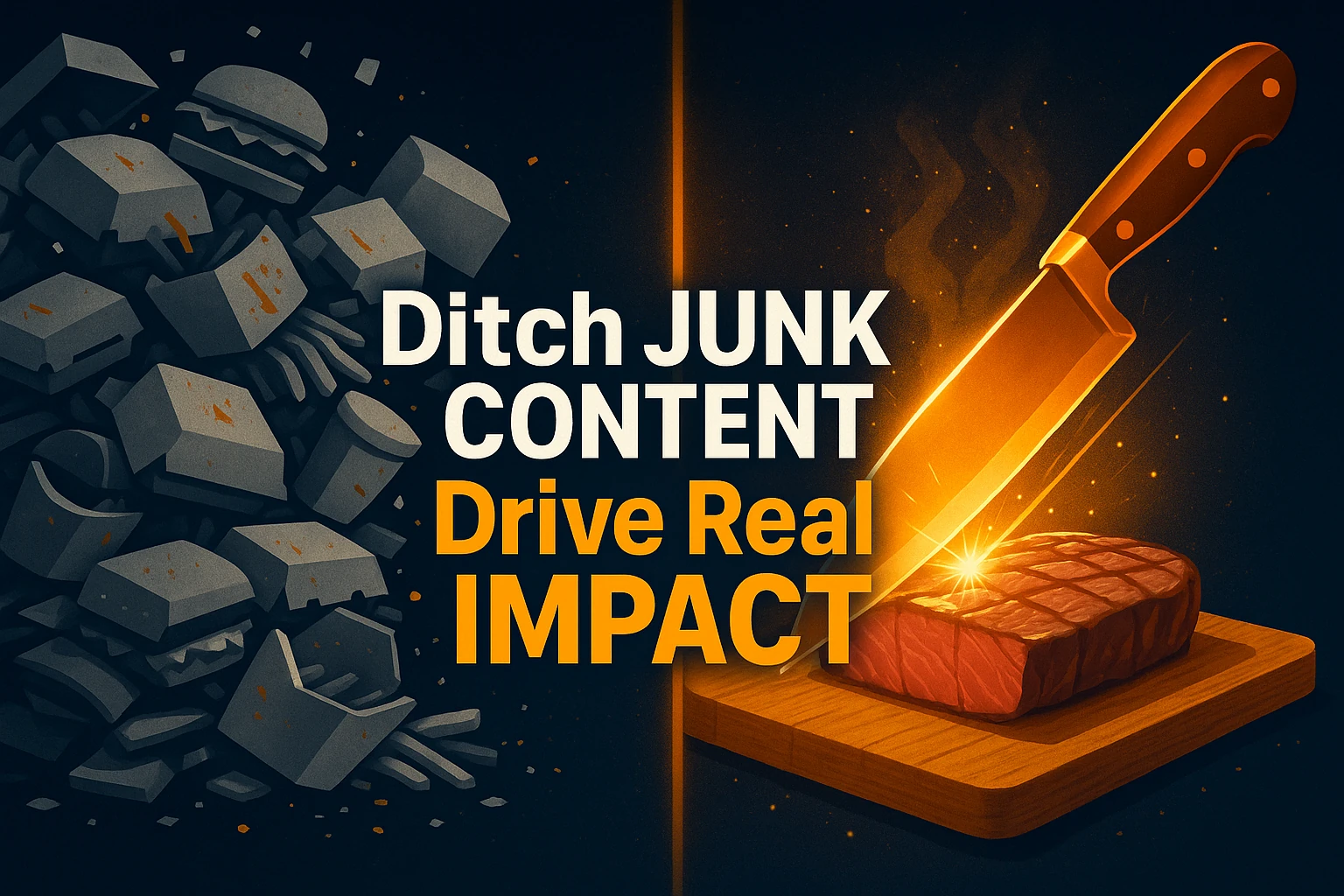
Think about junk food versus real, natural, nutrient-dense food. Junk food tastes amazing in the moment, but it lacks what really matters – nutrients. That's exactly what's happening with content right now.
What does content junk food look like? It's that high-volume, retention-tactic driven stuff we've all been creating. The "wait for it" videos. The artificial cliffhangers. The endless carousel posts that say nothing meaningful but hit all the algorithmic sweet spots. It gives viewers that quick dopamine hit, but leaves them feeling empty afterward.
And just like with actual junk food, people are getting sick of it.
Real food content, on the other hand, requires more effort to create but provides lasting satisfaction. It teaches something meaningful. It tells a compelling story that makes people return for the next episode – not because of some cheesy retention strategy, but because they genuinely care about what happens next.
The parallel to nutrition isn't accidental. Just as consumers increasingly choose quality ingredients over processed options, social media users are rejecting empty-calorie content in favor of substance over volume.
But here's where it gets interesting (and a bit scary if you're still playing the old game): platforms are actively enabling this shift. Instagram launched its "tune your algorithm" feature in January 2025, with major updates rolling out in September. Adam Moseri himself confirmed they're giving users granular control over their feeds. TikTok now allows 10-minute uploads, and I'm seeing brands create serialized content – like that rental management software company with their "Roomies" drama series.
The Data That Changes Everything
The proof is in the numbers, and they're pretty damning for the volume-first crowd.
Upskillist's September 2025 study found that long-form videos generate 10x more views and 5x more meaningful comments than short-form posts. Ten times. That's not a marginal difference – that's a complete paradigm shift.
I know content creators who are still posting seven times a week, wondering why their engagement is tanking. Meanwhile, their competitors who pivoted to posting two quality pieces weekly are absolutely dominating. One meaningful piece of content outperforms 10 shallow posts every single time.
The math is brutal: a 5-minute video with 35% retention now beats a 30-second video with 40% retention. Platforms reward watch time, not just views. Depth, not breadth.
So if I were to give you one piece of advice right now, it would be to start with a content audit. Look at everything you've posted in the last month and ask yourself: "Does this teach, inspire, or mean something to my audience?"
If the answer is no, don't post it. I'm serious.
The first practical step? Stop trying to do everything at once. Focus on narrative and storytelling that cuts through the noise. Prioritize meaningful engagement over virality. And for the love of all that's holy, ditch those cheesy retention strategies – they're not just ineffective now, they're actively repelling audiences.
The Stakes Have Never Been Higher
Here's what keeps me up at night: brands still operating on volume-based strategies won't just fail to grow. They'll lose the audiences they already have.
This isn't a minor course correction. This is a fundamental reset that will separate surviving brands from dying ones. You have a narrow window to pivot before being filtered out permanently by increasingly sophisticated, user-controlled feeds.
But if you get this right? You'll dominate markets while your competitors are still posting content junk food. You'll build deeper, more valuable audience relationships. You'll create content that drives views for years, not just days.
The choice is yours: keep serving empty calories, or start cooking real food.
Your audience is waiting to see which one you choose.