Table of Contents
The AI Slop Crisis: Why Your Marketing Team Is Drowning in False Confidence
How top performers use AI without getting burned
Picture this: You're in the boardroom, presenting your latest campaign strategy. The data looks bulletproof. AI gave you the perfect stat about consumer behavior that supports your entire argument. It's specific, compelling, and absolutely devastating to your case.
Three weeks later, you discover the stat was completely fabricated.
The source doesn't exist. The research was never conducted. And now you're scrambling to rebuild a campaign that was built on digital quicksand while trying to explain to your CEO why the "revolutionary AI efficiency" ended up costing you two weeks of rework.
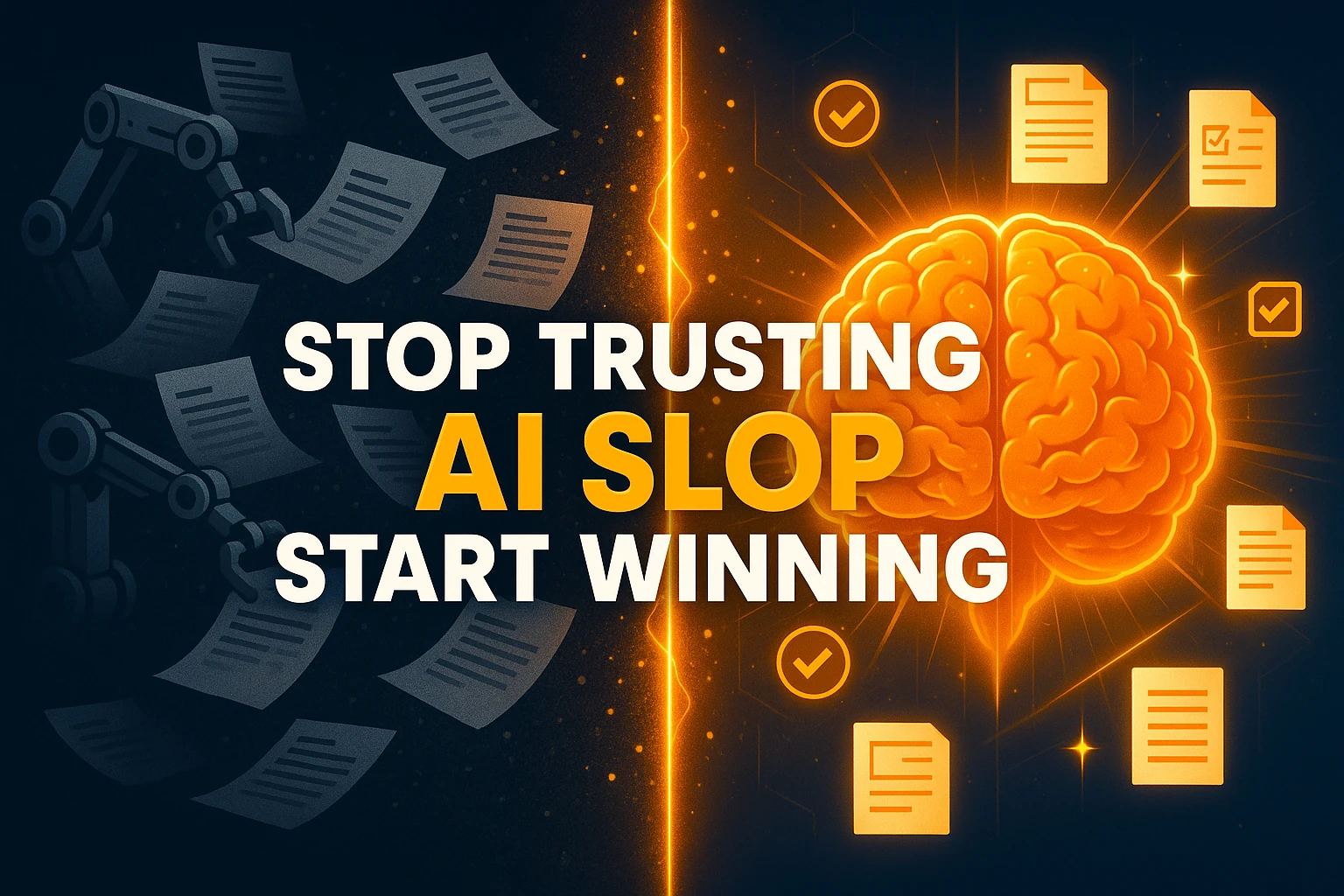
If this scenario makes your stomach drop, you're not alone. Every marketing team I know has their own version of this story. We're all drowning in what I call "AI slop" – the false confidence that comes from trusting machines that sound authoritative but can't tell fact from fiction.
The Intelligence Stack Most Teams Are Missing
Here's what I've learned after watching hundreds of marketing teams navigate this mess: there are two completely different ways to use AI, and most people are doing it wrong.
Think of it like the difference between using a calculator and using a compass. A calculator gives you definitive answers (when you input the right numbers). A compass points you in a direction, but you still need to navigate the terrain yourself.
Most marketing teams are treating AI like a calculator when it's actually a compass. They're asking for final answers instead of directional guidance. And that's where the AI Intelligence Stack comes in.
The bottom layer – what I call "Blind AI Usage" – is where most teams live. You feed AI a prompt, get confident-sounding output, and push it straight into your campaigns. No questions asked. No validation layer. Just pure faith in the machine.
But here's the kicker: I recently analyzed data from NP Digital comparing free and paid AI tools, and the hallucination rates were almost identical. Paying more doesn't make your AI more truthful. It just makes your false confidence more expensive.
The middle layer is where the magic happens – "Intelligent AI Usage." This is treating AI as your ideation partner, not your replacement. You use it for first drafts, not final drafts. For brainstorming, not decision-making. For speed, not accuracy.
And that top layer? That's your quality control system. It's the unsexy validation work that separates the pros from the casualties.
What the Smart Money Is Actually Doing
I know an agency owner who completely flipped their AI strategy last year. Instead of using AI to create more internal content faster (which was creating more problems than it solved), they started optimizing their content to be discovered by AI platforms.
The biggest ROI we're seeing from AI isn't from the tools themselves. It's from using AI platforms like ChatGPT as discovery channels to drive traffic and conversions.
Think about it: when someone asks ChatGPT for marketing advice, whose content gets cited? The people who understand how these platforms work and optimize for them. While everyone else is trying to replace their teams with AI, the smart players are making AI platforms work for them.
So if I were to give you one piece of advice, it would be to start with brutal honesty about your current AI usage. Cross-reference any stats AI gives you. Check the source. Verify the date. If something feels off, dig deeper – trust your human instinct over AI confidence.
The first practical step? Stop trying to do everything at once. Pick one workflow where AI is currently creating rework for your team. Build quality gates around it. Make validation mandatory, not optional.
And here's the uncomfortable truth about those AI efficiency layoffs we keep hearing about: companies are using AI as a cleaner story for public markets rather than admitting they overhired and divisions aren't growing at expected pace. As the Perplexity CEO said on CNBC: "It's not because of AI that people are losing jobs. In fact, because of AI, we see a lot more empowerment in people."
The real inefficiency isn't human judgment – it's the hours spent fixing AI errors that could have been prevented with proper validation.
The Real Choice Ahead
AI doesn't replace your judgment, it multiplies it. Once you understand that, you stop feeling threatened and you start feeling empowered.
The gap between teams using AI intelligently and teams drowning in AI slop is widening every day. While most marketing departments are still trying to figure out how to trust their AI tools, the top performers have moved past trust to strategic advantage.
Your choice isn't whether to use AI or not. It's whether you'll use it like everyone else does, or like the top performers do.