
Table of Contents
The Skeptic Economy: Why Being Human Is Your Only Unfakeable Competitive Advantage
In a world drowning in AI content, authenticity has become the ultimate business moat
You know that moment when someone casually mentions they "looked you up" before deciding to work with you? That split second when your stomach drops as you wonder what they actually found?
I was talking to a potential client last week who said something that stopped me cold: "I almost didn't reach out because your LinkedIn seemed... generic." Ouch. But here's what hit me harder – she was right to be skeptical.
Think about this for a second: 98% of employers now research candidates online before interviews. Ninety percent of people will vibe-check you before deciding to work with you. And here's the kicker – 79% have actually rejected someone based solely on what they found on social media.
Your personal brand isn't some future project you'll tackle when you have more time. It's happening right now, every single time you comment on a post, react to a story, or stay completely silent online.
The question isn't whether you have a personal brand. It's whether it's working for you or against you.
The HUMAN Framework: Your Trust-Building Blueprint
We're living in what I call the skeptic economy. Trust is at an all-time low, people are bombarded with AI-generated content from every direction, and everyone's built-in BS detector is working overtime.
But here's what most people are getting completely wrong about personal branding. They're still trying to hack algorithms and chase viral moments when the real opportunity is staring them right in the face.
The HUMAN Framework isn't about posting more content – it's about being more human in everything you share. Think of it like building a house: you need a solid foundation before you worry about the decorations.
First, you need to hook the right audience, not the biggest one. This isn't about casting the widest net possible. Your Instagram bio is your digital business card, and "I help entrepreneurs succeed" tells me absolutely nothing about you. Compare that to "I help entrepreneurs with neuro strategies build profitable businesses without burnout." See the difference? Specificity is magnetic.
Next comes the part most people skip entirely – actually understanding what keeps your audience awake at 2 AM. I'm not talking about demographics here. What are they secretly worried about? What solutions have they tried that didn't work? (Pro tip: scan the comment sections of your competitors' posts. That's where the real insights live.)
Then there's your message – and this is where AI simply cannot compete. They don't want content, they want context. They don't want information, they want your insights. They don't need more value, they want to know about your values.
The amplification phase is where most people burn out because they think it means posting constantly. Wrong. Instagram rewards conversations, not broadcasts. Show up more authentically, not necessarily more frequently. Behind-the-scenes content beats perfectly polished posts every single time.
Finally – and this is where 90% of people drop the ball – you actually nurture real relationships. Not follower counts. Relationships. Most people get the follow but never start the conversation.
The Stakes Have Never Been Higher
I know an entrepreneur who built a seven-figure business with a 500K+ community in under five years. No fancy funnels, no complicated strategies, no AI-generated content. Just by consistently showing up as herself online.
But here's what's really wild: while she was building authentic connections, her competitors were busy chasing the latest growth hacks. Guess who's still standing?
The data backs this up in a big way. Between 90-99% of your potential clients are lurkers – they're consuming your content, forming opinions about you, and making decisions without you even knowing they exist.
So here's my advice: start with an honest audit of your digital presence. Google yourself right now. What story does your online presence tell? Is it consistent across platforms? Does it feel authentically you?
Then fix your bio. Be specific about who you help and how. Replace those generic descriptions with something that actually means something.
But most importantly, prioritize conversations over broadcasting. Respond to every comment. Ask questions that spark real discussion. Be genuinely curious about other people's work. (And please, for the love of all that's holy, stop using AI to write your comments. I can smell that from a mile away.)
The Human Advantage
Here's what I've learned after watching thousands of business owners try to build their personal brands: the ones who succeed aren't necessarily the most polished or experienced.
They're the ones who show up consistently as themselves.
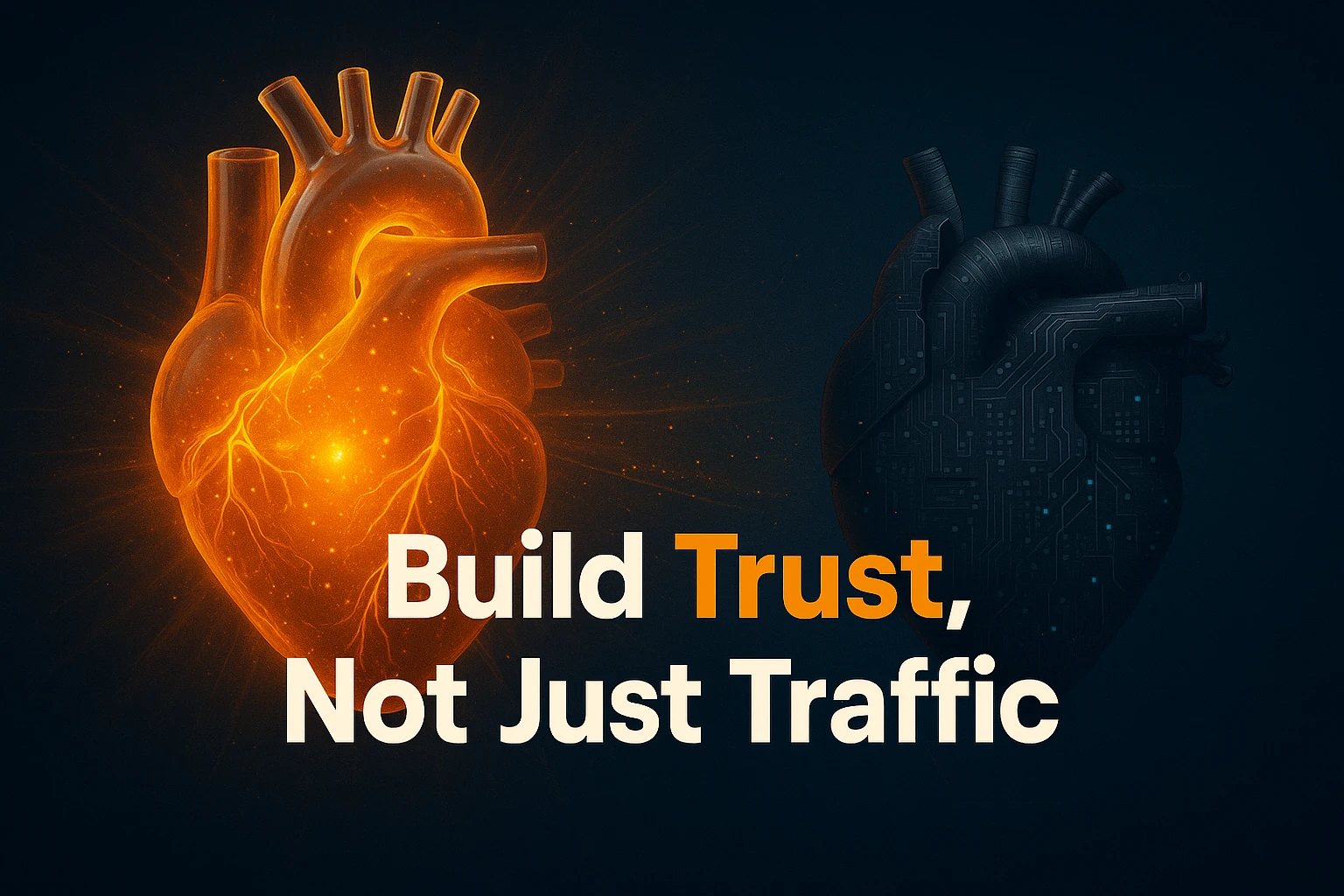
In a world where AI can generate endless content, being authentically human isn't just nice to have – it's your competitive moat. The skeptic economy rewards the people brave enough to be real in a sea of artificial everything.
Your personal brand is happening whether you're intentionally building it or not. The only question is: what story is it telling?