Table of Contents
The Death of the Marketing Funnel: Why Traditional Customer Journeys Are Extinct and What's Replacing Them
Your perfectly optimized funnels are hemorrhaging money because customers stopped using them
You know that sinking feeling when you're staring at your analytics dashboard, trying to figure out where the hell your customers are actually coming from?
Your attribution models show ghost customers materializing out of nowhere, buying immediately without touching your carefully crafted landing pages. Meanwhile, other prospects research extensively but never hit a single tracked touchpoint in your funnel. You've optimized email sequences, A/B tested landing pages, and perfected retargeting campaigns, but something feels fundamentally broken.
Here's what's really happening: You're measuring a customer journey that doesn't exist anymore.
I was looking at some data the other day, and what I found was staggering. Google Lens now processes 20 billion visual searches monthly, 4 billion of those are shopping-related. Think about this for a second: people are pointing their cameras at products they see in TikTok videos and getting instant purchasing options. No landing page. No email sequence. No funnel.
That's just one example of how customers have completely bypassed the infrastructure we've spent years building.
The Post-Funnel Reality: How Discovery Actually Works Now
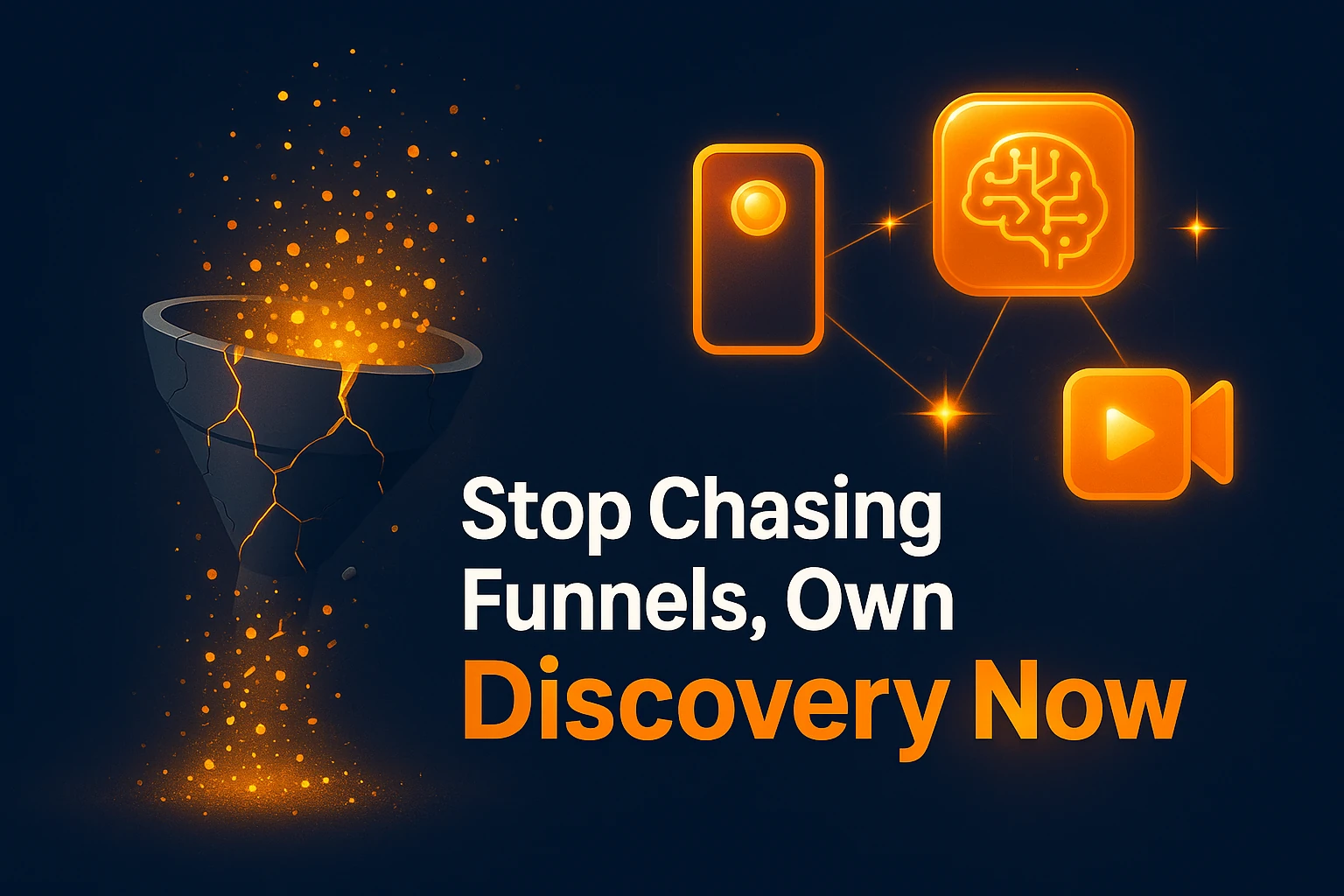
The traditional marketing funnel assumed customers moved linearly from awareness to consideration to purchase. But buying doesn't happen in funnels anymore; it happens across discovery ecosystems.
What replaces the funnel? I call it the 5 Pillars of Post-Funnel Marketing, and it's not sequential at all. It's more like a mesh network where customers can enter anywhere and purchase through any other channel.
Visual-first discovery is the foundation of how people shop now. When someone sees a product they like, whether it's in a video, on a friend, or in a store, they don't search for it by typing keywords. They point their camera at it. Amazon reported a 70% year-over-year increase in visual searches because it's simply faster than trying to describe what you saw.
But here's where it gets interesting: AI-mediated buying has completely disrupted traditional search behavior. A recent Yelp report found that 66% of frequent shoppers now use AI assistants for purchasing decisions, with 34% using them specifically for initial product discovery. When someone asks ChatGPT to recommend winter coats, they're not seeing your Google ads or landing pages. They're getting curated recommendations that either include your brand or don't.
And that's the core of it. No, wait, that's not quite right. The real core is that customers no longer ask "Is this good?" They ask "Is this better?"
AI and visual search make comparison effortless. Every product recommendation comes with alternatives. Customer loyalty has become conditional by default, which means your messaging needs to be comparison-first from the start.
Meanwhile, live commerce integration is collapsing the entire decision timeline. The live streaming shopping market is projected to explode from $38.87 billion in 2022 to $256.56 billion by 2032. Facebook alone sees 57.8% of users making purchases during live shopping events because it eliminates research friction entirely.
Finally, ecosystem omnipresence means being discoverable everywhere customers actually search, not just Google. Instagram processes 6.5 billion searches monthly, YouTube handles 3 billion, and TikTok is the primary product discovery platform for 77% of Gen Z. (If you ask me, most brands are still acting like Google is the only search engine that matters.)
The Opportunity Hidden in Plain Sight
Here's what most people miss: This isn't about emerging trends. These are mainstream behaviors happening at massive scale right now.
I know marketing directors who are still pouring budget into funnel optimization while their actual customers are discovering products through AI conversations that completely exclude Amazon. That's a huge opportunity for smaller brands, by the way, ChatGPT shopping recommendations aren't dominated by the biggest players yet.
So if I were to give you one piece of advice, it would be to start with an audit of your current discovery presence. Search for your products using Google Lens. Ask ChatGPT for recommendations in your category. See what comes up when people search for your type of product on Instagram or TikTok. You might be shocked by how invisible you are in the places where buying decisions actually happen.
The first practical step? Stop trying to optimize your existing funnel and start building presence where customers are already looking. Focus on high-quality multi-angle product images that visual AI can process. Make sure your product specifications are clear and complete so AI assistants can recommend you accurately.
Then experiment with live commerce formats, even if it's just Instagram Live product demos. The cost of missing actual revenue sources is much higher than the investment in new channels.
Remember: 67% of online shoppers now say high-quality product images are more important than descriptions or reviews. We've moved into a visual-first, AI-mediated, comparison-driven buying environment, and the brands that recognize this shift first are the ones that will dominate their categories.
The Real Stakes
Your customers have already moved beyond funnels. The question is: will your marketing catch up before your competitors do?
The companies that adapt quickly to post-funnel marketing will reach customers in high-intent moments, when they're pointing cameras at products or asking AI for recommendations. The companies that keep optimizing ghost funnels will keep wondering why their attribution doesn't match reality.
If AI doesn't know you exist, your customers won't either.