Table of Contents
Why Press Kits Are Your Secret SEO Weapon: How to Control Your Narrative When the Media Finds You
Most businesses celebrate press coverage without realizing they're missing the biggest SEO opportunity hiding in plain sight.
You know that feeling when you finally get press coverage for your business? You're scrolling through your phone, heart racing with excitement, clicking on the link to see your company featured in a real publication. Then you read it.
"That's... not really accurate," you think, somewhere between grateful and disappointed. The journalist tried their best, sure, but they were clearly on deadline, did some quick research, and got it kind of wrong. They completely missed what you actually do. Or worse, they described your innovative fintech platform as "just another app."
Every business owner who's gotten any press has lived this exact moment. That mix of gratitude (we got coverage!) and frustration (but they didn't get it right) is so universal it's almost comedic.
But here's what most people don't realize: this frustration isn't just annoying, it's a massive strategic blind spot that's costing you serious SEO juice.
The Press Kit SEO Triple Play
What if I told you there's a way to control your narrative and turn every piece of press coverage into strategic backlinks to your money pages? Most SEOs are missing this completely, but smart businesses use what I call "The Press Kit SEO Triple Play."
Think about it like this: every time a journalist writes about you, they're essentially creating a high-authority backlink and brand mention. The question is whether you're going to let them waste that opportunity or strategically direct it.
Here's how most businesses handle press opportunities, and why each approach either kills or multiplies your SEO potential:
The first scenario, and honestly, the most common one, is what I call the wasted opportunity. A journalist finds your company, maybe through social media or a tip. They spend 15 minutes researching you (if you're lucky), then write something thin that's not completely accurate. You have zero control over how you're described, which keywords get associated with your brand, or where they link. The result? Press coverage that barely moves the needle for conversions or rankings.
Then there's the panic response, which happens when success hits fast. Journalists start reaching out, you're scrambling, and you end up writing something yourself while you're rushing between meetings. It's poorly thought out because you're in reactive mode, not strategic mode. You miss the chance to include your target keywords, strategic internal links, or compelling copy that actually converts readers into customers.
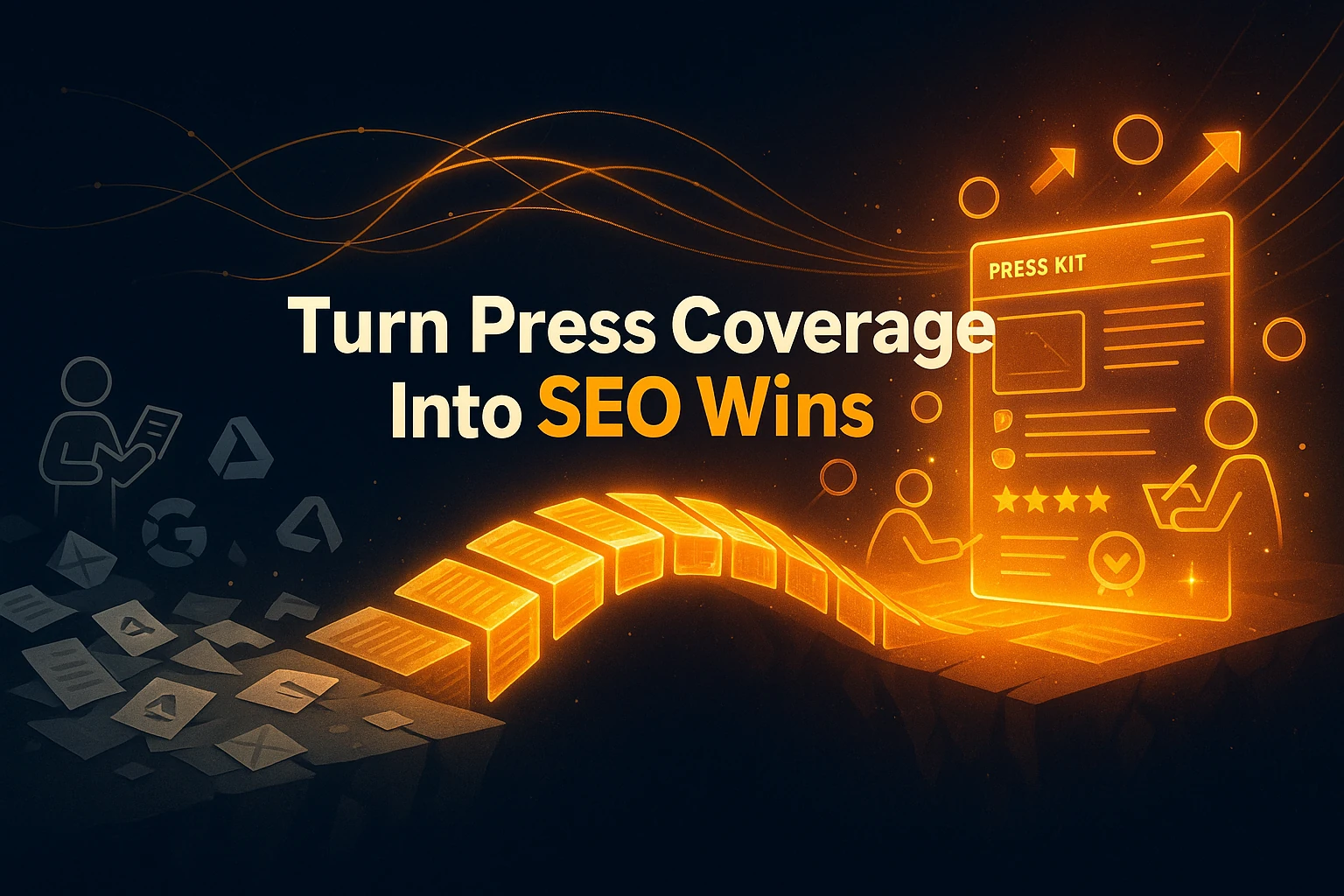
But here's the scenario that changes everything, the strategic advantage. You've already built a comprehensive press kit page on your website (not buried in some Google Drive folder). When a journalist searches for information about your company, they immediately find this resource. And here's the beautiful part: they often just copy and paste your write-up because journalists are busy and want things to be easy.
Suddenly, every piece of press coverage uses your exact language, your chosen keywords, and includes links to your highest-priority pages. You're not hoping they get it right, you're guaranteeing they do.
Why This Actually Works (And Most SEOs Miss It)
I was talking to an SEO expert the other day who reminded me of something Rand Fishkin figured out back in 2012. Google is constantly pattern matching and associating entities with each other. When "Consumer Reports" gets mentioned alongside "cell phone ratings" enough times, Google builds that topical authority connection, even without direct links.
You want your brand associated with the entities and keywords you're actually targeting, not whatever tired journalist decides to call you.
The technical proof is fascinating. I know someone who spent two hours converting their old Google Drive press kits into proper website pages. Within weeks, Google Search Console showed the canonical URL changing from the Google Drive link to their actual domain once Google crawled the new setup. The link juice started flowing to their money pages instead of disappearing into Google's cloud.
And here's the thing about journalists (having worked with plenty of them): they're not trying to misrepresent you. They're just busy, often working on tight deadlines, and dealing with way too many stories. When you make their job easier by providing exactly what they need, they'll use it.
So here's my advice if you want to turn press coverage into an actual SEO weapon:
First, create a strategic press kit page on your website, not Google Drive, not a PDF download, but a real webpage. Include your AB-tested sales copy, your target keywords naturally worked into the description, and strategic internal links to your pillar pages that link to your money pages. Add a contact form, phone number, your best images with proper alt text, and an OG image optimized for social sharing.
Next, optimize it for discovery. Use an SEO title like "Press Kit | [Your Brand Name]", link to it from your footer so journalists can find it instantly, and make sure it's obviously designed for media use with clear labeling.
The advanced move? Periodically update those internal links based on your current SEO campaigns. Right now you might want press coverage linking to your new service page, but in six months you might rotate that to focus on a different pillar page. You control exactly where that link juice flows.
The Compound Effect Most People Never Consider
Here's what happens when you get this right: your messaging doesn't just appear in one article, it spreads. The next journalist who covers your industry might reference that first article. LLMs training on web content start associating your brand with your chosen keywords. Your narrative becomes the default narrative.
Without a press kit, you're letting tired journalists and hallucinating AI tools define your brand story while you watch valuable link opportunities slip away.
Very few SEOs know to do this, which means there's still time to get ahead of your competitors. But every piece of press coverage without a strategic press kit behind it is a wasted opportunity that you can't get back.
The question isn't whether you'll get press coverage, if you're doing anything interesting, you probably will. The question is whether you'll control your narrative when it happens, or let someone else write your story for you.