Table of Contents
The Psychology-Driven Video Strategy: Why Most Business Owners Create Content That Never Converts
And the brain science framework that turns viewers into paying clients
You've seen it happen a thousand times at restaurants. The waiter takes your complex order, no onions on the burger, dressing on the side, extra fries instead of chips, and somehow remembers every detail perfectly. But the instant that plate hits your table? Complete mental blank. Ask for extra napkins and they look at you like you're speaking Mandarin.
This isn't incompetence. It's your brain doing exactly what it's designed to do.
The moment a task feels "complete," your mind releases it from active memory. Psychologists call this the Zeigarnik Effect, named after Bluma Zeigarnik who documented this phenomenon in 1920s restaurants. And here's what's fascinating: this same psychological principle is secretly sabotaging every piece of video content you create.
Think about this for a second: how many of your videos get decent views but generate zero client inquiries? How many people watch your content, nod along, maybe even leave positive comments, then completely forget about you the moment they click away?
They're not ignoring you on purpose. Their brains are literally designed to forget you.
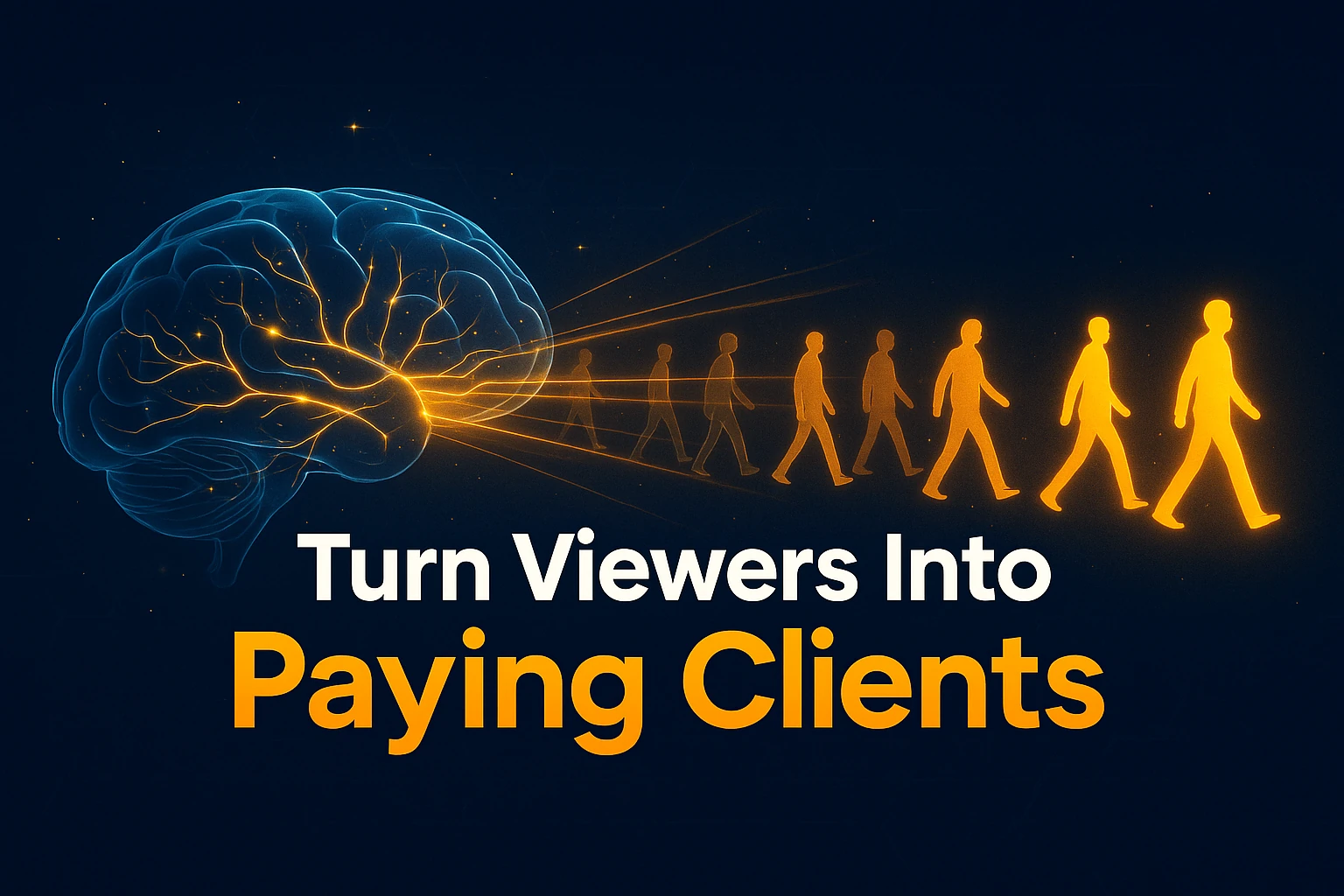
The 3-Stage Viewer-to-Client Conversion System
Most business owners making videos completely ignore the invisible layer underneath their content, the documented brain science that actually drives conversion. They focus on production quality, engagement metrics, and view counts while missing the psychological triggers that separate successful channels from those that just rack up meaningless vanity metrics.
I've been studying this gap between content creation and conversion psychology, and what I've found is a systematic approach that works with your viewers' brains instead of against them.
What if your videos could do the heavy lifting of selling without feeling salesy? Here's how the psychology actually works.
The first challenge isn't getting clicks, it's preventing the mental exit that happens within ten seconds. Your viewers' brains are constantly scanning for completion signals, looking for permission to move on to something else. Most videos accidentally trigger this release by delivering their main point too early or wrapping ideas in neat, tidy packages.
But you can engineer your content differently. Think of it almost like every open loop is a small thread that your viewer is holding. The more threads they're holding, the harder it becomes for them to leave. You create these threads by teasing specific revelations, like mentioning "the one phrase that makes anxiety worse" early in your video but not revealing it until much later.
This leverages anticipation response in the brain. When people know a reward is coming, their dopamine system fires up, creating a neurochemical reason to keep watching.
The second stage is where most business videos completely fall apart. Getting attention is one thing. Converting that attention into trust? That requires triggering entirely different psychological mechanisms.
Your viewers need to feel like they know you before they'll consider hiring you. This happens through what researchers call parasocial bonding, the one-way relationship people form with media personalities. You accelerate this by strategically sharing personal struggles that mirror your audience's experience and showcasing client results with specific outcomes.
The brain responds to similarity. When you admit past mistakes or use your viewer's exact language, you trigger similarity attraction. When you share concrete client transformations, you activate social proof and consensus principles.
The final conversion stage is where conventional wisdom gets it completely backward.
Most business owners hoard their best strategies, thinking scarcity creates value. But when you teach generously, when you give them the real information, the actual strategy, the stuff that actually helps, you trigger reciprocity. They feel like they owe you something at that point.
This isn't manipulation. It's basic human psychology that's been documented for decades.
The Proof Is in the Brain Science
I know a consultant who was ready to delete her YouTube channel after six months of crickets. Decent views, positive comments, zero clients. Then she learned about psychological triggers and changed one thing: instead of saving her best content for paying clients, she started giving it away for free.
Ninety days later, she landed her first $10,000 client directly from YouTube.
The neuroscience backing this up is rock solid. When you provide genuine value first, you create measurable brain chemistry changes. The anticipation effect literally fires up dopamine pathways. The reciprocity principle activates the same neural networks involved in social bonding.
This isn't marketing theory, it's measurable psychology that's been studied since the 1920s.
So if I were to give you one piece of advice, it would be to start auditing your current videos through this psychological lens. Where are you accidentally triggering completion? Where are you missing opportunities to build parasocial bonds? Where are you gatekeeping instead of giving?
The first practical step? Stop trying to perfectly package your insights. Leave some threads hanging. Make your viewers hold onto those psychological loops.
Most of your competitors are still focused on content volume and production quality. They're missing the invisible layer underneath content that actually drives conversion, the documented psychological principles that turn views into revenue.
Your videos can do the heavy lifting of selling, but only if you engineer them with your viewers' brains in mind. The choice is yours: keep creating content that entertains but never converts, or start leveraging the brain science behind conversion.
The psychology has been documented for nearly a century. The question is whether you'll use it before your competitors figure it out.