Table of Contents
The ROAS Trap: Why Optimizing for High Returns is Killing Your Facebook Ad Growth (And What Smart Advertisers Do Instead)
The uncomfortable truth about why your "successful" campaigns are secretly capping your business growth
You're staring at your Facebook ads dashboard, and the numbers look incredible. 4x ROAS across the board. Your boss is happy. Your clients are sending congratulatory emails. You're hitting every KPI in the book.
So why has your business been stuck at the same revenue for the past six months?
I've been looking at this pattern for years now, managing campaigns for brands you probably shop with online, and what I've discovered is staggering. That beautiful ROAS you're so proud of? It's actually an invisible ceiling that's preventing your business from scaling. You're essentially paying Facebook to show ads to people who were already going to buy from you anyway.
Think about this for a second: ROAS only measures how efficiently you convert existing demand. It doesn't measure how well you create new demand. And that distinction is everything.
The ROAS vs. Growth Paradox Framework
Here's what nobody talks about in those "How to Scale Your Facebook Ads" videos on YouTube. There are really only two paths you can take with your advertising strategy, and they create completely opposite outcomes.
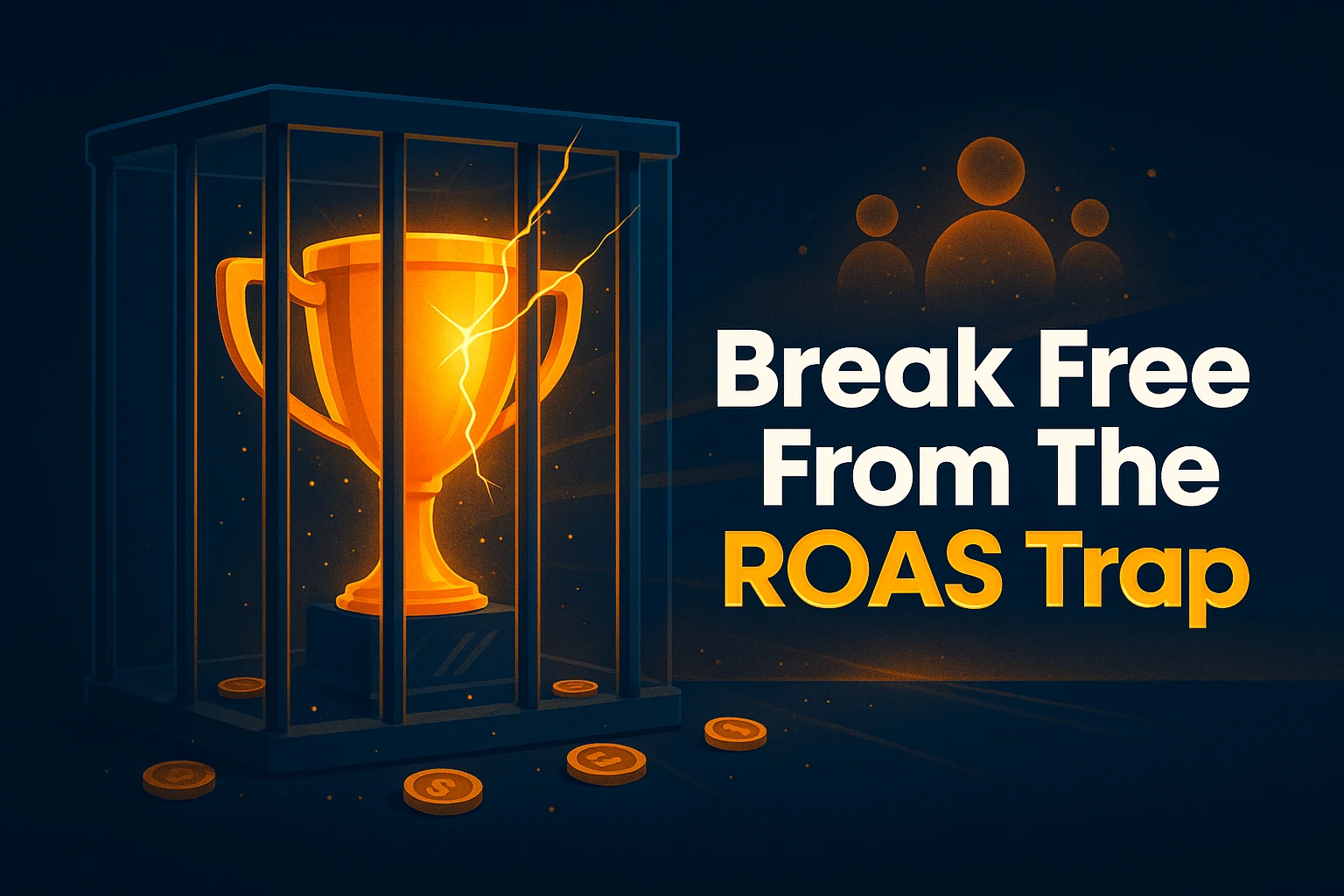
Most advertisers fall into what I call the ROAS trap without realizing it. You start optimizing primarily for high return on ad spend because, well, it feels good. Higher returns must mean better performance, right? But here's the brutal reality: this creates an invisible ceiling by training Facebook's algorithm to focus only on existing demand. The algorithm gets lazy. It starts showing your ads to people who are already close to buying – your email subscribers, people who've visited your website multiple times, customers who are about to make a repeat purchase anyway.
You end up with great short-term metrics but stagnant long-term growth.
The alternative is the demand creation path, and it requires a completely different mindset. Instead of optimizing for efficiency first, you optimize for new customer acquisition and expanding your addressable audience. You're essentially telling Facebook to constantly find new people who've never heard of your brand instead of recycling the same buyers over and over.
The outcome? Lower short-term ROAS, but exponential long-term growth.
It's like the difference between fishing in the same small pond every day versus exploring new waters. Sure, you know exactly where the fish are in that pond, and you'll catch them efficiently. But once you've caught them all, you're done. The smart angler is always finding new places to fish.
The Proof is in the Numbers
I know an agency owner who manages over $600 million in ad spend, and he showed me a case study that perfectly illustrates this paradox. One of his Shopify clients was stuck – I mean completely flatlined – between $170K and $260K in monthly revenue for six straight months. Their ROAS? A "healthy" 3-5x the entire time.
Then they made the switch. They started excluding existing customers, created new educational content focused on first-time buyers, and accepted a lower ROAS in exchange for reaching net new audiences. The result? Revenue exploded to $758K in the following months.
But here's what really opened my eyes. When I started tracking the data patterns across multiple accounts, I found something fascinating: whenever the returning customer rate climbed above 60%, growth would stall. Every single time. It didn't matter how good the ROAS looked – when Facebook was primarily showing ads to people who already knew the brand, scaling became impossible.
Look at the brands that have achieved explosive growth recently. IM8 Health went from zero to $100 million in one year. Athletic Greens scaled from zero to $500 million in two years. Companies like Ski, AG1, Blenders, Peloton – they all understand this principle. They're willing to accept lower ROAS in exchange for constant demand creation.
So here's my advice if you're ready to break through your growth plateau: Start by auditing your current approach. Go into your analytics and check if your returning customer rate is above 50-60%. If it is, you're stuck in the ROAS trap.
Next, create custom audiences in Facebook Ads Manager to exclude your website visitors from the last 180 days and all past purchasers. Force the algorithm to focus only on net new customers. Then develop fresh creatives – education-based content, product demos, and first-time buyer focused messaging. Your old creatives have engagement history tied to existing customers.
Most importantly, shift your success metrics. Stop asking "What's our ROAS?" and start asking "How many new people saw us today? How many new customers did we acquire?"
The Bottom Line
The goal is not the highest ROAS possible. The goal is the lowest ROAS you can afford at the highest volume you can handle.
You're literally trading off a win today for a bigger win tomorrow. And if you only optimize for ROAS, you stay efficient, but you stay small. The choice is yours: perfect metrics or exponential growth. But you can't have both.