Table of Contents
Why Your CEO's AI Replacement Strategy Will Backfire: The Strategic Case for Human-AI Hybrid Teams in Content Creation
The companies winning with AI aren't replacing their content teams, they're transforming them into strategic weapons.
Your CEO just walked into your office with that look. You know the one. They've been reading about AI breakthroughs again, and now they're asking the question every content manager dreads: "Can't we just use AI for all this content creation and save money?"
The silence that follows feels eternal. Your mind races through defensive arguments about human creativity and brand voice, but you know how those sound to a bottom-line-focused executive. Cost center justifying its existence.
Here's the thing though, your CEO isn't wrong to ask. They're just asking the wrong question.
I've been in marketing for over a decade, managing teams from 2 to 12 people, and I've lived through this exact conversation. What I discovered when I actually tested the "replace everyone with AI" approach changed everything about how I frame these discussions with leadership.
The 80/20 Content Transformation Model Changes the Game
The real opportunity isn't replacement, it's transformation. And the companies that get this right are going to absolutely crush their competition.
Think about it this way: What if 80% of your current content work could be handled by AI, freeing your team to focus entirely on the 20% that actually drives business results? Not fewer people doing the same work, but the same people doing exponentially more valuable work.
Let me break this down because the math is staggering.
The AI Foundation Layer handles everything that's currently eating up your team's time. First drafts, data gathering, basic production tasks, even initial content creation. This isn't theoretical, I doubled our content production using AI tools last year. But here's what happened that nobody talks about: our engagement metrics were completely flat after a month of analysis.
Flat. Despite doubling our output.
Why? Because we were creating what I now call "commodity content." Generic stuff that checked all the boxes but missed the human element entirely. The content that AI creates on its own doesn't deliver what audiences really need, and it doesn't deliver the engagement, sales, or any other KPIs we actually measure.
That's where the Human Strategic Layer becomes your competitive advantage. This is the 20% where humans excel and AI falls flat. Strategic thinking, emotional intelligence, asking the right questions, understanding the quiver in a customer's voice during an interview.
I learned this the hard way when we interviewed a customer about our time management software. The AI could have analyzed the transcript and pulled out features and benefits all day long. But it couldn't see what I saw, the emotion when they talked about how our tool helped them avoid layoffs and actually increase productivity during tough times. That human insight became one of our best-performing pieces of content.
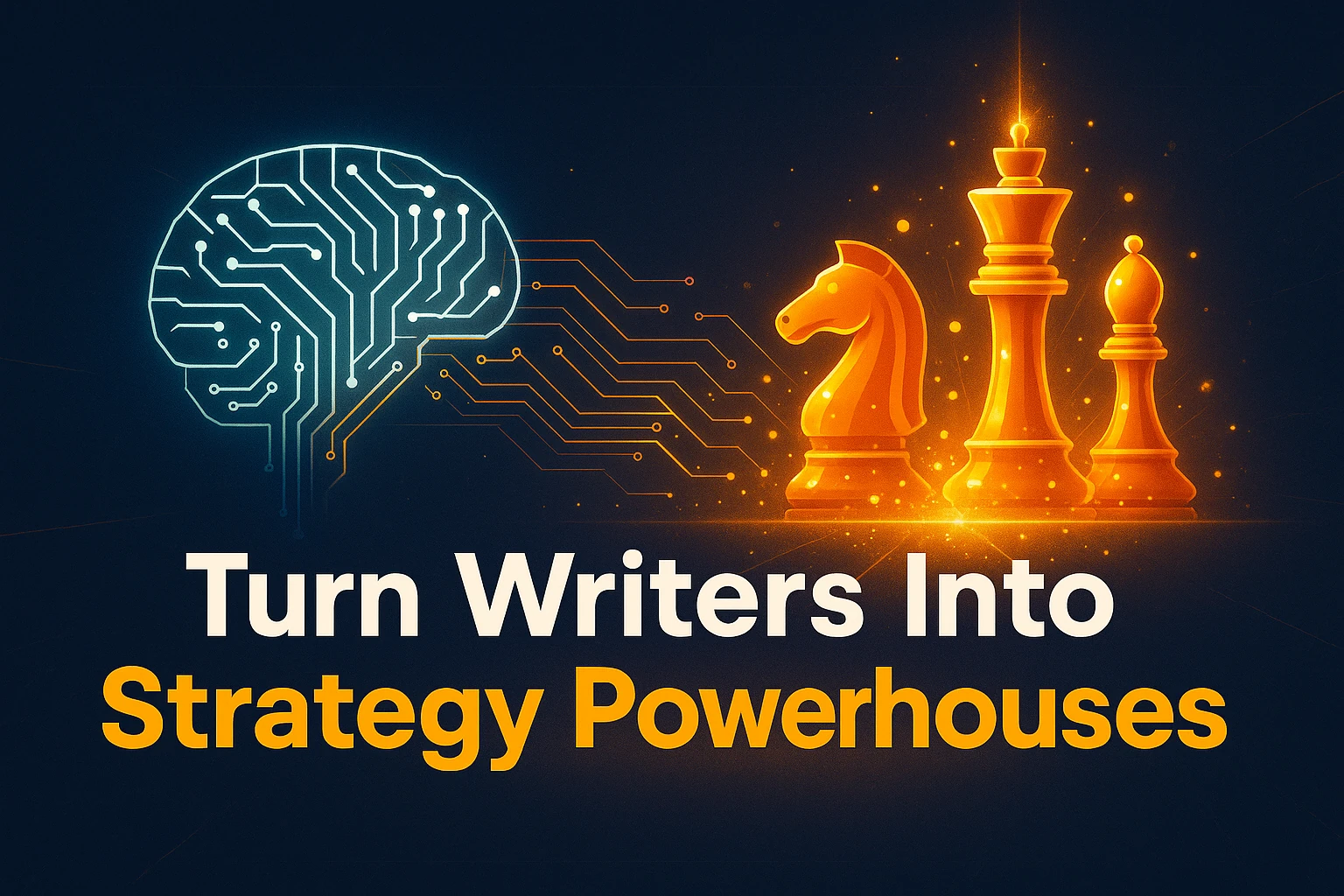
Here's the transformation that changes everything: instead of having junior creators and senior strategists, everyone becomes a strategic thinker with AI as their amplifier. Strategic copywriters. Strategic AI designers. Strategic data analysts.
The Conversation Your CEO Actually Wants to Have
So when your CEO asks about replacing your content team with AI, here's exactly what to say:
"We don't pay our creative team as writers or designers. We're paying them as strategic thinkers and strategic creators for our brand."
This reframes the entire conversation. You're not defending a cost center, you're positioning your team as a strategic weapon.
The first practical step? Start auditing your current team structure right now. Which roles are stuck in the 80% (repetitive creation work) and which are operating in the 20% (strategic value creation)? Then map out how AI tools can handle the foundation work while your humans focus on the strategy.
I know a marketing director who restructured her entire team this way. Instead of fighting the AI conversation, she embraced it and used it to eliminate the junior positions that were hardest to fill anyway. Everyone got elevated to strategic roles, and their output quality improved dramatically because humans weren't burning cycles on busy work.
But here's the critical part, address team anxiety early. The worst thing you can do is let your people think their jobs are disappearing. They're not. They're evolving. And the people who master this hybrid approach are going to be incredibly valuable.
The companies that try to go full AI create commodity content that sounds like everyone else. The companies that go full human get buried under production demands. But the companies that nail the human-AI hybrid? They get both scale and strategic insight.
The Strategic Reality Check
Your CEO is going to make this decision with or without you. The question is whether your team becomes a strategic weapon or gets replaced by the marketing equivalent of generic store-brand cereal.
The window for this transformation is right now. CEOs are asking this question in boardrooms across the country, and the teams that can articulate their strategic value will thrive. The ones that can't will get replaced.
My take has always been this: AI can answer your questions brilliantly, but it can't ask good questions. It can't see the strategic opportunity in a customer's emotional response. It can't navigate the complex relationship between brand voice and audience psychology.
That's your 20%. That's where you win. That's what makes your team irreplaceable, not as creators, but as strategic thinkers who happen to use AI as their most powerful tool.
The companies that figure this out first are going to dominate their markets. The question is: will yours be one of them?