Table of Contents
Creative is the New Targeting: Why Meta's Evolution Killed Traditional Audience Definitions Forever
The algorithmic shift that's making demographic targeting obsolete
You've noticed this pattern, haven't you? You click on an ad, maybe it's someone sitting at a desk talking about ROI or dashboard analytics, and suddenly your feed is flooded with nearly identical ads. Same setup, same hook, same visual language. You probably assumed it was just marketers copying each other's successful formats.
Think about this for a second: what if I told you that's not copycatting at all? What you're witnessing is Meta's algorithm recognizing that you responded to specific creative signals and systematically finding more content that generates those exact same signals.
This isn't coincidence. It's algorithmic sophistication that most marketers still don't understand.
And here's the kicker, if you're still building campaigns around age ranges, job titles, and interest categories, you're fighting a war that ended two years ago.
The Creative Signal System Changes Everything
Let me walk you through what actually happened to Meta's targeting system (and why everything you learned about Facebook ads is probably outdated).
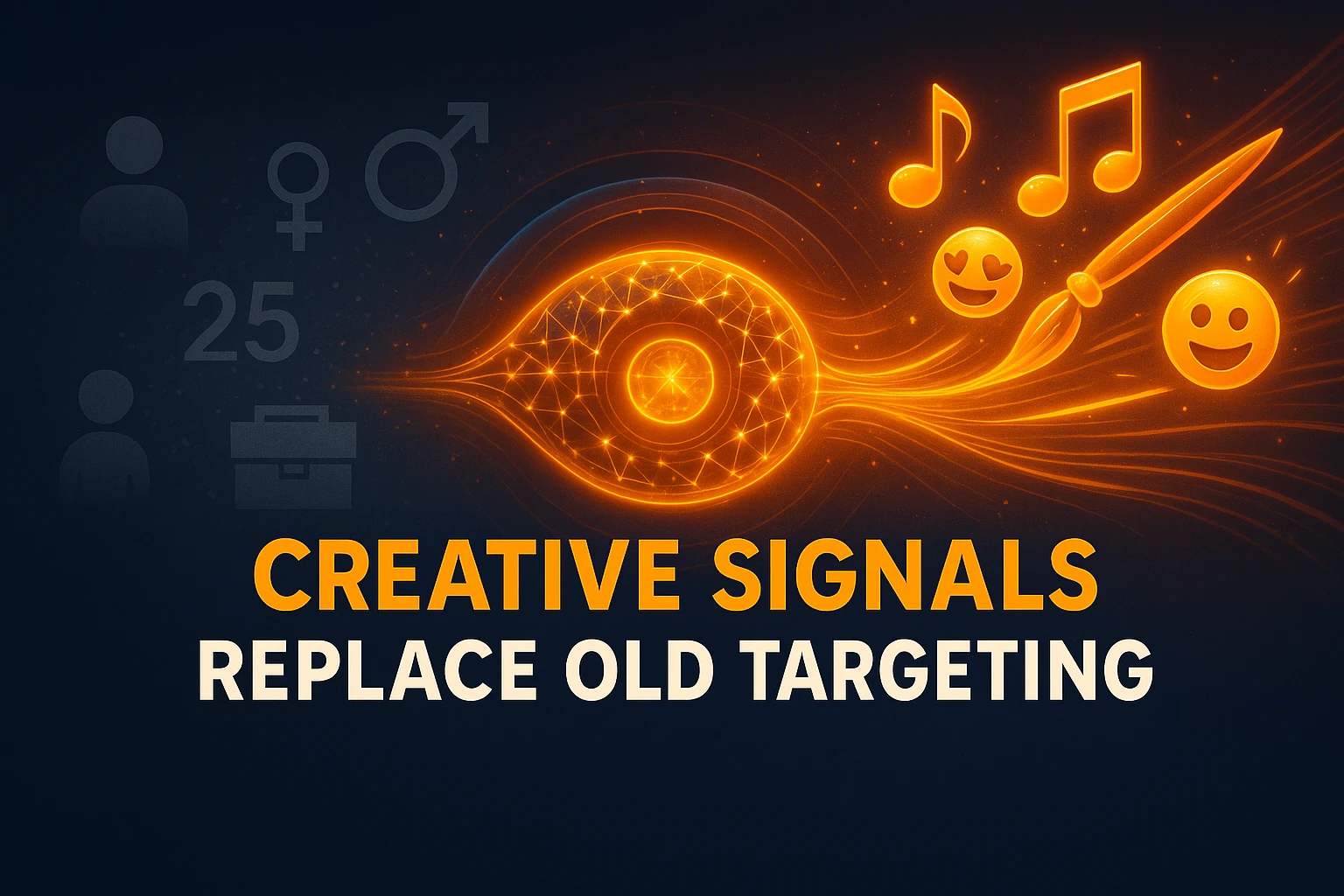
The old Meta worked like a filing cabinet. You'd describe the person first, 25-45 years old, interested in fitness, works in marketing, lives in major cities. Then you'd show them an ad. The platform took your demographic instructions and delivered your creative to people who fit that profile.
But here's what changed: privacy updates, iOS tracking limitations, and the sheer impossibility of serving billions of people daily made this approach obsolete. As one advertising expert put it, "Creative is the new targeting...In the current meta ads world, you describe the moment, motivation, and identity and that all through the creative itself."
What does that actually mean?
Instead of telling Meta who to target, you're now showing Meta what kind of moment your ad speaks to through your creative choices. Your visuals, spoken words, on-screen text, pacing, scenario, framing of the problem, and type of proof, all of these become signals that Meta interprets to understand what problem this ad solves and what emotional state it addresses.
The platform has essentially flipped the equation. Rather than finding people who match a demographic profile, it finds people whose current mindset, motivation, and decision-making state align with the creative behavior patterns your ad represents.
Here's How This Plays Out in Practice
I was talking to an agency owner last week who finally understood why his campaigns started working better when he stopped overthinking audience definitions. He'd been creating separate ad sets for "small business owners," "marketing managers," and "entrepreneurs", classic demographic thinking.
Instead, he started thinking in buyer motivation angles. Pain-driven angles for people frustrated with their current solution. Proof-driven angles for skeptical buyers who needed case studies. Identity-driven angles for people who wanted to see themselves as innovative. Value-driven angles for cost-conscious decision makers.
Each angle became its own creative treatment, not its own audience.
Meta finds the right people because, as the system has evolved, "your creative tells Meta what problem this ad speaks to, what emotional state it aligns with, what identity it reflects, and what kind of user would stop, watch and act."
The platform can now identify micro-audiences based on creative behavior patterns rather than broad demographic categories. Someone might be a 45-year-old CEO and a 25-year-old startup founder, but if they're both in a "frustrated with current tools" mindset, they'll both see your pain-driven creative.
So here's my advice: stop trying to describe your ideal customer and start describing the ideal moment when someone needs your solution.
First practical step? Check if Meta is giving you primary text optimization suggestions or creative similarity warnings. These are your canary in the coal mine, they tell you whether your creative is sending clear signals or confusing the algorithm.
The second move is restructuring your campaign architecture entirely. Use fewer ad sets (1-2 maximum) with many creative variations and broader targeting. The fragmentation approach that worked in Old Meta actually prevents the algorithm from learning effectively now.
If creative is the new targeting, then angles are the new audiences.
The War You're Actually Fighting
The marketers who figure this out first aren't just getting better performance, they're accessing Meta's most sophisticated audience discovery system while their competitors waste budget on outdated demographic definitions.
But here's what keeps me up at night: this shift isn't coming. It's already here. Every day you spend optimizing interest categories and age ranges is a day your competition pulls further ahead using creative signals to unlock micro-audiences you didn't even know existed.
The question isn't whether you should adapt to this new reality. The question is whether you can afford to keep fighting yesterday's war while everyone else has moved on to tomorrow's battlefield.