Table of Contents
Why Most Facebook Ad Scaling Strategies Are Algorithm Suicide (And The 4-Campaign Method That Actually Works)
The popular "one campaign method" is destroying more ad accounts than it's scaling
Picture this: You wake up Monday morning and check your Facebook ads dashboard. That campaign you've been nursing for weeks finally hit 8x ROAS over the weekend. Your heart races. This is it, the winner you've been waiting for.
So you do what every YouTube guru told you to do. You spike the budget from $50 to $200 overnight. Maybe even $300, because why not ride the wave, right?
Tuesday morning hits different. Your CPA has tripled. ROAS dropped to 2x. The campaign that was printing money 24 hours ago now looks like expensive performance theatre. Sound familiar?
Here's what nobody's telling you: Most advertisers don't realize they're breaking the algorithm while trying to scale. The scaling advice flooding your feed? It's designed for companies already spending $50,000+ daily, not the business owner trying to get from $500 to $5,000 without going broke in the process.
The 4-Campaign Scaling System: A Different Approach to Growth
I've been studying accounts that successfully scale, companies like Loop earplugs that went from $1,000 to $50,000 daily spend, or brands like Rise running 5,500+ active ads. After managing over $600 million in ad spend, I've noticed something that challenges everything you've heard about the "one campaign method."
The brands that scale consistently don't put all their eggs in one campaign basket. They use what I call the 4-Campaign Scaling System, a sequential process that treats different budget levels like different games entirely.
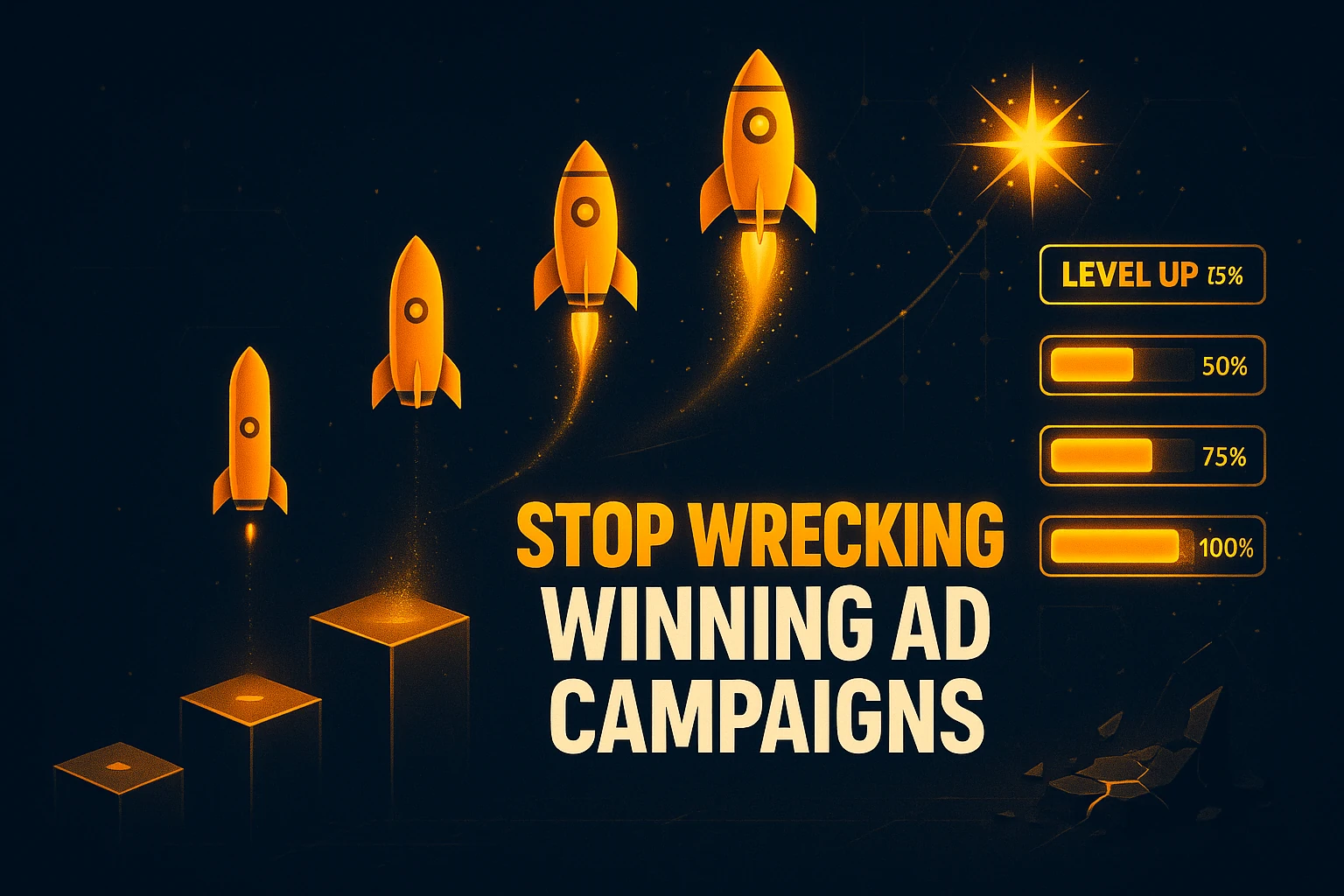
Think of it like a video game with four distinct levels. You can't skip Level 2 and jump to Level 4 just because you got good at Level 1. Each level requires different strategies, different patience levels, and different risk tolerances.
What makes this system work? It prevents the single biggest mistake I see advertisers make: budget cannibalization. When you have one campaign doing everything, testing creatives, scaling winners, optimizing audiences, your budget gets pulled in too many directions. Your best-performing ad ends up stealing budget from your testing budget, which means you stop discovering new winners right when you need them most.
The beauty of this approach is how each campaign type handles a specific phase of growth, creating a pipeline that feeds into itself. Your testing campaign discovers winners, your migration campaign validates them at scale, your vertical scaling campaign grows them systematically, and your rapid scaling campaign pushes them to the stratosphere.
But here's where it gets interesting, and where most people mess up the execution.
How the System Actually Works in Practice
Let me walk you through what this looks like with real numbers, because the devil is always in the details.
Your creative testing campaign should be getting dedicated budget for trying new hooks, angles, and UGC content. I know one agency client, Ki Eyewear, that has 740 active ads running at any given time using exactly this strategy. They're not testing everything in their main scaling campaign. They have a separate budget specifically for discovering what works next.
Once you find those 8x, 6x, or 15x ROAS winners, here's what most people get wrong: they immediately spike the budget on the same campaign. Instead, you migrate those winning creatives to your scaling campaigns, retargeting audiences, Advantage Plus campaigns, lookalikes. This gives you even spend distribution and prevents any single audience from getting oversaturated.
Now comes the part that separates the pros from the amateurs: vertical scaling with the 20% rule. Every three days (not daily, not weekly), you increase your ad set budgets by exactly 20%. This keeps you under the learning phase reset threshold while building momentum. You do this religiously until you hit around $200-500 daily spend per campaign.
Here's the kicker, and why timing matters so much in 2026. Once you cross that $500 daily threshold, the game changes completely. Suddenly you can increase budgets by $100-500 every three days because your account has enough volume that learning phase resets recover immediately. Companies like HOS are running 11,000+ active ads across multiple accounts using this exact progression.
The secret sauce? Something called microbudget shifting. Instead of always increasing total spend, you reallocate budget from lower-performing audiences to higher-performing ones. You can scale revenue without touching your overall budget. Shift $25-50 increments toward your best ROAS performers, and watch your overall account efficiency climb.
Why This Matters More Than Ever
If you ask me, 2026 is going to separate the advertisers who understand systematic scaling from those still chasing the latest creative hack. Creative volume wins, but only when you have the infrastructure to support it.
The brands that will dominate aren't the ones with the flashiest ads, they're the ones with the most sophisticated scaling systems. While everyone else is burning budgets on 500% overnight spikes, you'll be building sustainable growth that compounds month after month.
The choice is yours: keep playing algorithm roulette with the one campaign method, or build a system that actually works with Facebook's learning phases instead of against them.
Because here's the truth nobody wants to admit, most scaling strategies are just expensive ways to break what's already working.