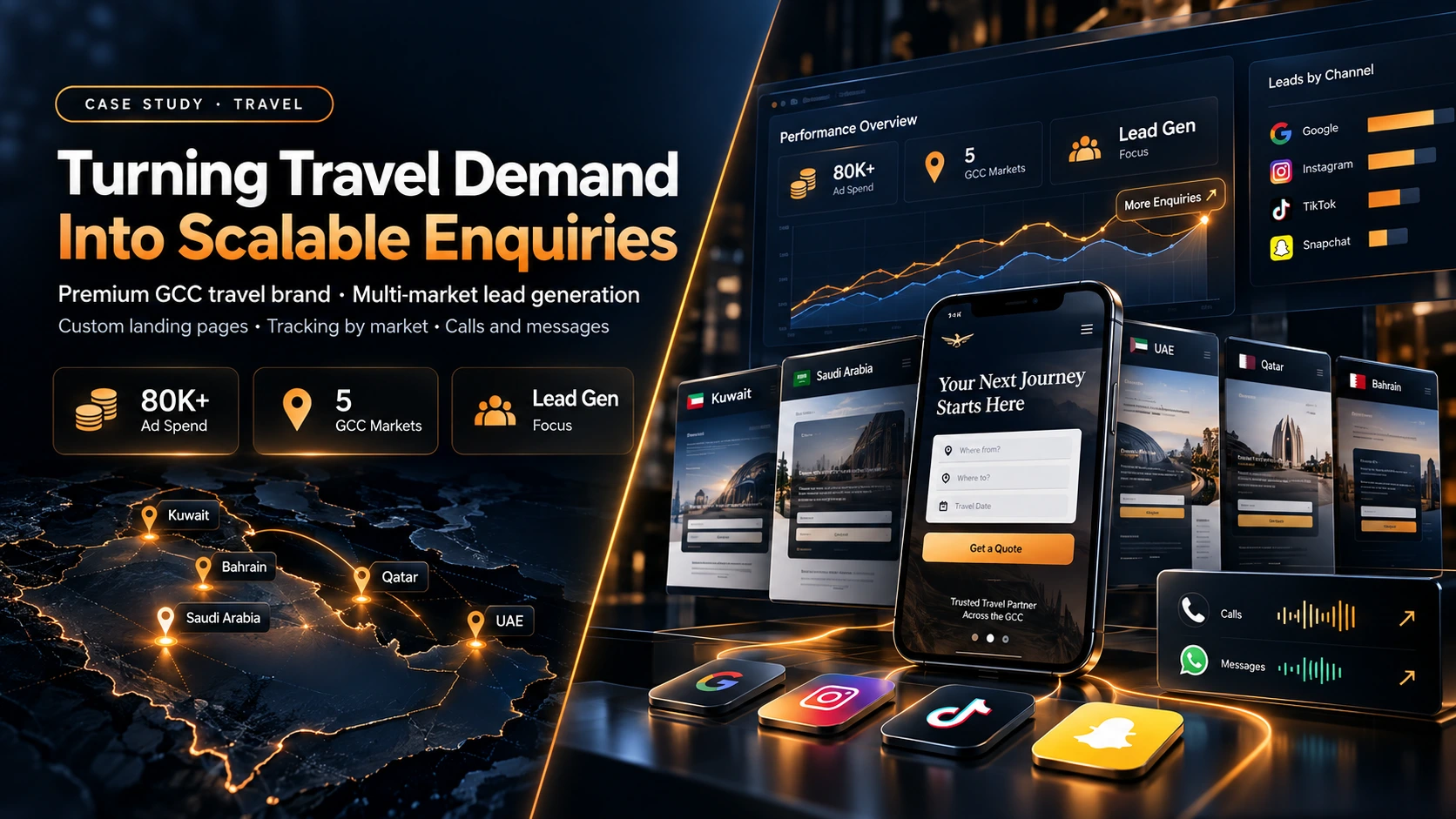
Five Markets. One Adaptive Acquisition System.
How I led paid media, market-specific conversion journeys and continuous destination-led optimization for a premium GCC travel brand.
*Campaign-level conversations and follower results are distinct measures, not a combined lead count.
The business challenge
The client sold premium, full-service travel programs across Kuwait, Saudi Arabia, the UAE, Qatar and Bahrain. The objectives went beyond reach: generate messages and calls from prospective travellers, build audiences and maintain demand for travel programs across markets with different customer behaviour.
A shared regional approach made it harder to understand which destinations, offers, messages and conversion journeys were working in each country. The challenge was to build a system that could adapt by market and by travel demand, while making performance measurable and investment decisions more informed.
The strategic insight
Travel demand does not behave like a fixed product catalogue. Some destinations have seasonal peaks; others attract interest throughout the year. I used those demand patterns to guide the mix of destinations, content, campaigns and landing-page messages rather than keeping the same approach running unchanged.
Seasonal demand
Adapt promoted destinations, packages, creative angles and landing-page content as customer interest changes.
Year-round demand
Keep proven destinations visible while continually testing messaging, media and conversion paths.
My responsibility: Digital & Performance Marketing Manager | Meta/Instagram · TikTok · Snapchat · Google Ads
Which market, destination, message and landing-page combination deserves more investment now?
The answer changed as customer demand and campaign performance changed. The process was designed around testing and reallocation, not assuming every metric or every destination would improve at once.
Managing the entire growth system
Optimization was continuous and cross-functional. I treated campaign performance, content, market demand, landing pages and measurement as connected decisions, not separate marketing tasks.
Turn one regional view into five measurable market journeys
Built a country-specific landing-page path and separate tracking/reporting for Kuwait, Saudi Arabia, the UAE, Qatar and Bahrain. This made it possible to assess and refine each market independently.
Plan around changing destination demand
Balanced seasonal destinations with programs that attracted year-round interest. Adjusted destination focus, package messaging, creative angles and campaign priorities as demand changed by market.
Keep landing pages and content in the optimization loop
Regularly tested and revised landing-page copy, content, customer-facing messages and conversion paths instead of assuming the ad alone determined lead performance.
Run different objectives without confusing their outcomes
Managed Meta, TikTok, Snapchat and Google Ads across awareness, video, audience development, traffic and direct enquiries. Messages and calls remained the core lead-generation goals.
Make budget decisions from evidence, not habit
Compared campaign performance, cost and response by objective; retained promising combinations, adjusted weaker approaches and redirected investment when results justified it. Not every test worked, and no single metric always improved.
The operating rhythm
This same decision framework applied across the markets, but the execution differed with audience behaviour, seasonality and campaign performance.
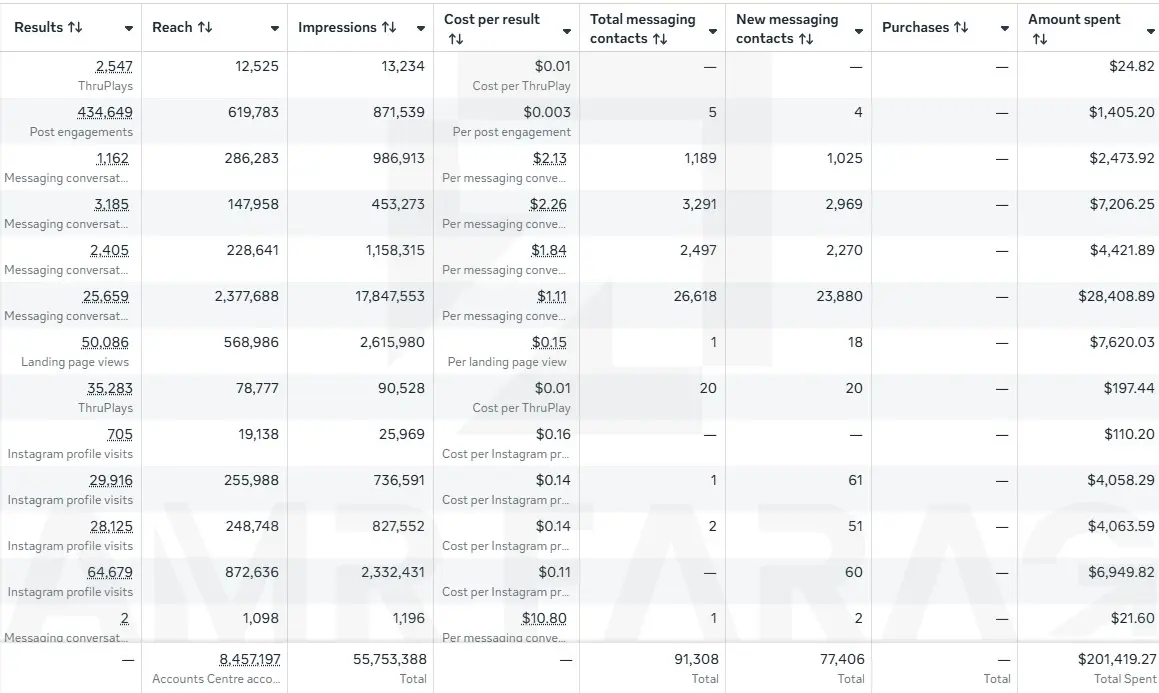
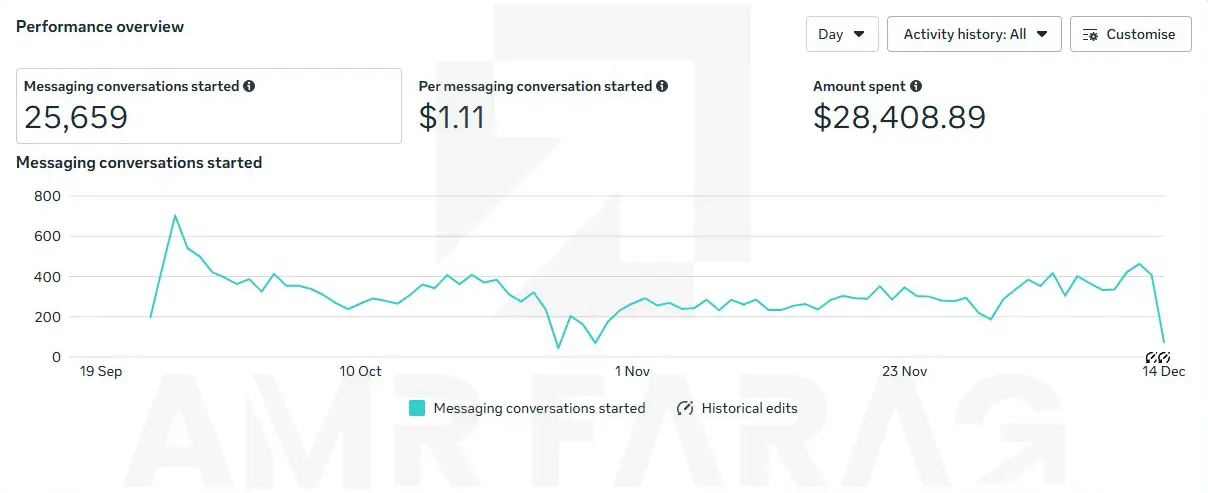
In a selected Meta messaging campaign set, one campaign generated 25,659 messaging conversations at approximately US$1.11 each. It represented around 67% of the set’s messaging spend but delivered around 79% of its messaging conversations.
This illustrates resource allocation within the campaigns shown; it is not an all-market or lifetime comparison.
Evidence beyond the headline
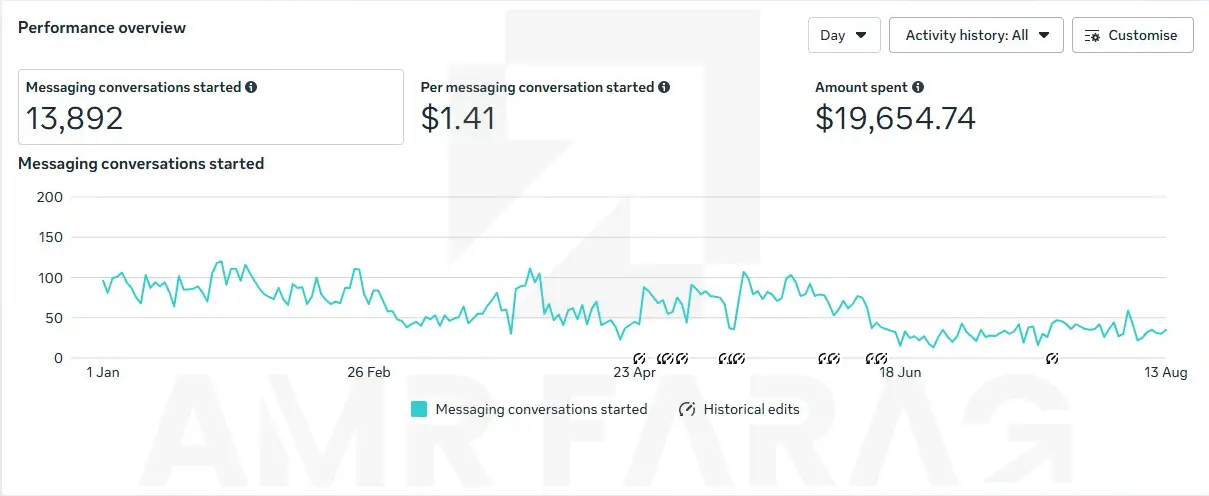
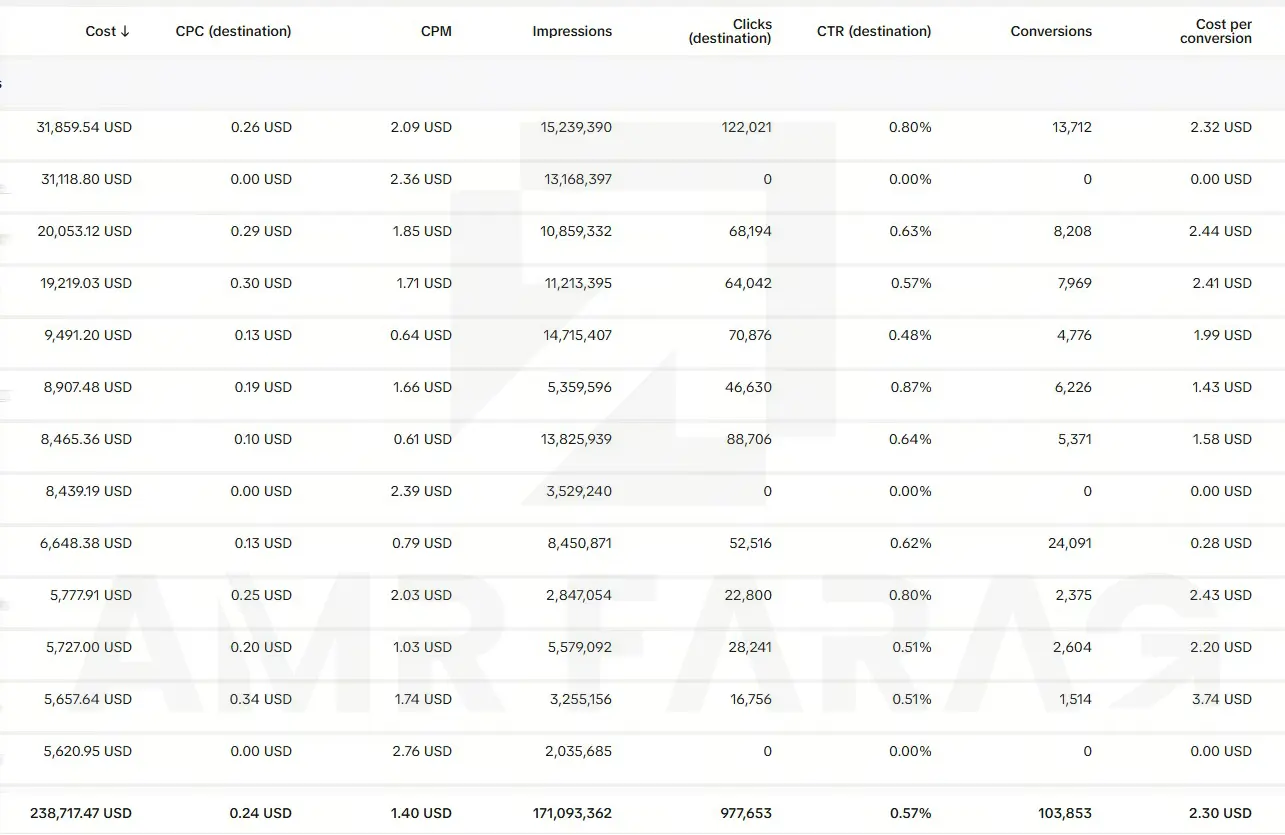
I managed US$640,198.26 in reported media investment across four platforms. The account supported multiple objectives, so engagement actions, conversations, followers and platform-specific results are presented separately.
Media investment by platform
| Platform | Reported spend | Share of spend |
|---|---|---|
| TikTok | US$328,591.40 | |
| Meta / Instagram | US$239,949.04 | |
| Snapchat | US$46,423.03 | |
| Google Ads | US$25,234.79 | |
| Total | US$640,198.26 |
By reported objective
Selected outcomes from the source reports
| 25,659conversations · ~US$1.11 each | One selected high-volume Meta messaging campaign in Saudi Arabia. |
| 91,308 / 77,406total / new messaging contacts | Meta account summary shown in the supplied campaign report; contacts are not bookings. |
| 64,679Instagram profile visits · ~US$0.11 each | One selected audience-development campaign. |
| 404,195platform-reported follower results | 321,291 TikTok + 82,904 Meta, reported in the combined platform summary. |
What this delivered for the business
The concrete operational change was a more adaptable acquisition process: five market-specific enquiry journeys, separate measurement, content and offers responsive to travel demand, and ongoing campaign and landing-page experimentation. The platform reports document substantial marketing activity and selected efficient acquisition outcomes; they do not establish attributed bookings or revenue growth.
My role
I led regional performance strategy, channel and budget planning, demand-led campaign direction, landing-page and CRO decisions, tracking, ongoing testing, reporting and client communication. My contribution was the management of the connected system, not simply the operation of individual ad accounts.
Connect calls and messaging enquiries to CRM lead qualification, confirmed bookings and destination-level revenue. That would allow investment decisions to progress from response cost toward actual commercial return by market and offer.
Measurement note. Platform “results” refer to different campaign objectives and are not summed into one lead KPI. Campaign examples use different reporting scopes. Follower figures are platform-reported. Booking-level attribution, qualified-lead counts and revenue ROI were not independently verified in the supplied evidence.
From the ad accounts
Common questions
How do you run performance marketing for a travel agency across several GCC countries?
I turned one regional approach into five market journeys. Kuwait, Saudi Arabia, the UAE, Qatar and Bahrain each got their own landing-page path and separate tracking, so each market could be measured and improved on its own.
Which ad platforms were used, and how was the budget split?
Of US$640,198 in reported spend: TikTok 51.3%, Meta/Instagram 37.5%, Snapchat 7.3% and Google Ads 3.9%. Messages and calls were the core lead-generation goals.
How do you handle seasonal travel demand in paid ads?
Seasonal destinations get fresh destinations, packages, creative angles and landing-page content as interest changes. Year-round destinations stay visible while messaging, media and conversion paths keep being tested.
What did a messaging conversation cost?
In one selected Meta campaign in Saudi Arabia, 25,659 conversations cost about US$1.11 each. That campaign used around 67% of the set's messaging spend and delivered around 79% of its conversations.
Do the results show bookings or revenue?
No. The platform reports show marketing activity and efficient acquisition. They don't prove bookings or revenue. The next step is connecting calls and messages to a CRM to track qualified leads and confirmed bookings.